
Home Workouts vs. Gym Training: Weighing the Trade-Offs

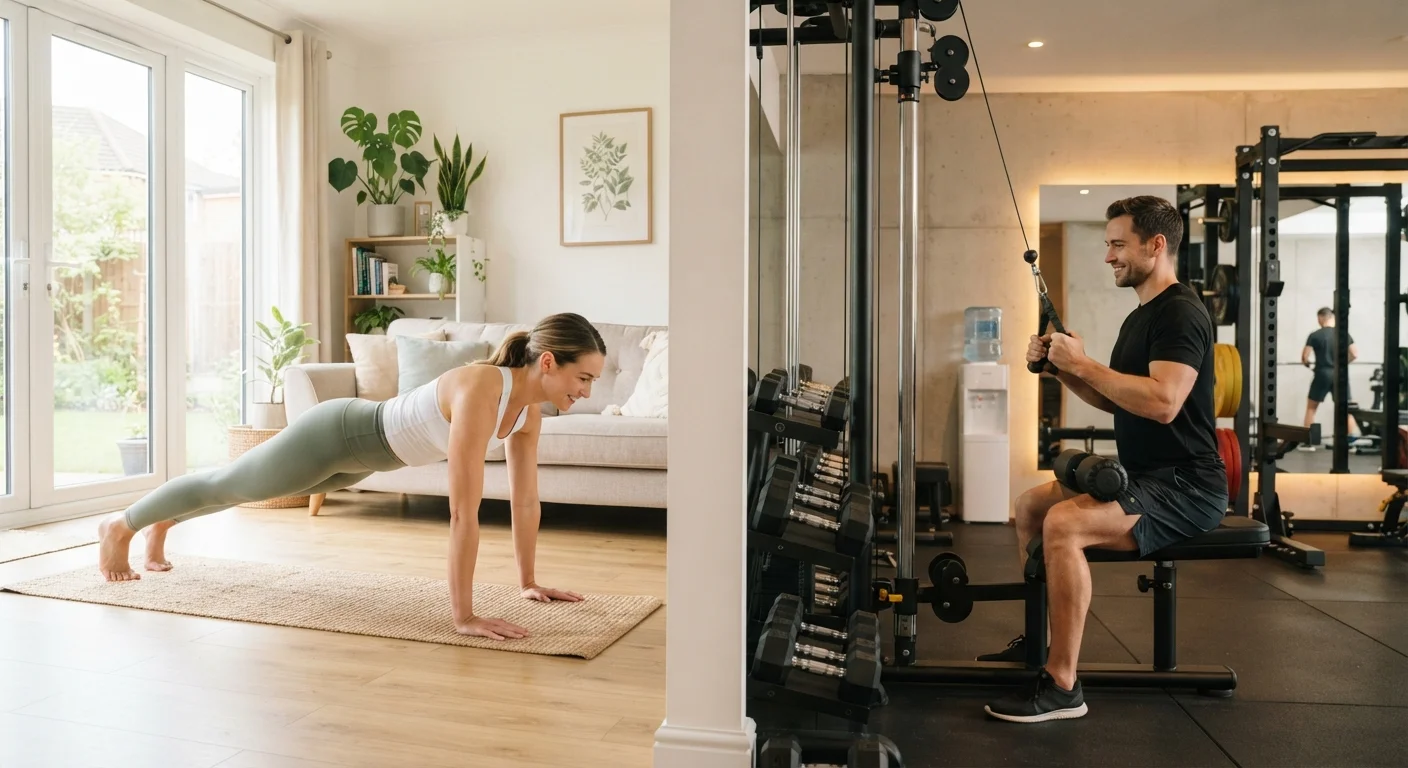
Photo: UltraSearches.com | Search Results You Can Trust editorial
Key Takeaways
- Home workouts eliminate commute time and cost, but may limit equipment variety and progression options.
- Gyms provide access to specialized equipment and social motivation, at the cost of membership fees and travel.
- Research shows consistent effort matters more than training location for long-term fitness outcomes.
- Hybrid approaches - combining home and gym sessions - work well for many people.
- Your personal schedule, budget, and motivation style should drive the decision, not trends.
No commute - train when and where it suits you
Removing travel time lowers the activation energy required to exercise, which research links to better long-term adherence. A 10-minute home session can happen where a 60-minute gym trip might not.
Low ongoing cost once equipment is purchased
A modest home setup - resistance bands, a mat, adjustable dumbbells - requires a one-time investment with no monthly fees. Over several years, the savings relative to a gym membership can be substantial.
Privacy removes social anxiety as a barrier
Many beginners report feeling self-conscious in commercial gyms. Training at home eliminates that concern entirely, allowing focus on form and effort without distraction.
Easy to integrate rest and recovery habits
Being at home makes it simpler to combine workouts with stretching, foam rolling, or other recovery practices without time pressure. See our article on why rest days matter for context.
Limited equipment constrains progressive overload
Continuing to challenge muscles progressively - a key principle for strength and hypertrophy - becomes harder without a broad range of resistance options. Beginners outgrow basic bodyweight progressions faster than many expect.
Distractions and interruptions are harder to avoid
Household responsibilities, family members, or the temptation of screens can fragment focus and reduce training quality. Creating a dedicated space helps, but it's not always possible.
Lack of professional guidance increases injury risk for beginners
Without a trainer or experienced training partners nearby, beginners may reinforce poor movement patterns without realising it. Quality form instruction - especially for compound lifts - is harder to access at home.
Why the Setting Matters - But Not as Much as You Think
The debate between training at home and going to the gym often gets framed as an either/or contest. In practice, exercise science is fairly clear: the stimulus your muscles and cardiovascular system receive matters far more than the room you're standing in. A well-structured bodyweight session at home and a well-structured barbell session at the gym can both drive strength, endurance, and health improvements.
That said, the environment you choose does shape your habits, your access to tools, and your long-term adherence - and those factors compound over months and years. As covered in our article on how the body adapts to regular exercise, showing up repeatedly is the single biggest driver of progress, regardless of where you show up.
With that framing in place, it's worth examining the genuine trade-offs each setting brings.
Advantages and Disadvantages of Home Workouts
Training at home has grown substantially in popularity, and for good reason - the barriers to entry are low, and the flexibility is high.
No commute - train when and where it suits you
Removing travel time lowers the activation energy required to exercise, which research links to better long-term adherence. A 10-minute home session can happen where a 60-minute gym trip might not.
Low ongoing cost once equipment is purchased
A modest home setup - resistance bands, a mat, adjustable dumbbells - requires a one-time investment with no monthly fees. Over several years, the savings relative to a gym membership can be substantial.
Privacy removes social anxiety as a barrier
Many beginners report feeling self-conscious in commercial gyms. Training at home eliminates that concern entirely, allowing focus on form and effort without distraction.
Easy to integrate rest and recovery habits
Being at home makes it simpler to combine workouts with stretching, foam rolling, or other recovery practices without time pressure. See our article on why rest days matter for context.
The limitations are real, though. Without a range of weights or machines, it can be harder to apply progressive overload - gradually increasing resistance over time - which is a core principle behind muscle development and strength gains. Many beginners exhaust bodyweight progressions faster than expected and hit a plateau without investing in additional equipment. Space constraints and noise concerns (for apartment dwellers) can further restrict exercise selection.
Limited equipment constrains progressive overload
Continuing to challenge muscles progressively - a key principle for strength and hypertrophy - becomes harder without a broad range of resistance options. Beginners outgrow basic bodyweight progressions faster than many expect.
Distractions and interruptions are harder to avoid
Household responsibilities, family members, or the temptation of screens can fragment focus and reduce training quality. Creating a dedicated space helps, but it's not always possible.
Lack of professional guidance increases injury risk for beginners
Without a trainer or experienced training partners nearby, beginners may reinforce poor movement patterns without realising it. Quality form instruction - especially for compound lifts - is harder to access at home.
For a broader look at what different training types deliver physiologically, see our guide on cardio vs. strength training.
Advantages and Disadvantages of Gym Training
A commercial gym provides access to equipment that would be prohibitively expensive or spatially impractical for most home setups. Cable machines, squat racks, rowing ergometers, and a full spectrum of resistance levels let exercisers apply precise, scalable challenge to every muscle group.
~$50/month
Average U.S. gym membership cost
According to data compiled by fitness industry analysts, the median American gym membership runs between $40 and $70 per month, not including initiation fees or add-on classes.
~23%
Adults meeting both aerobic and strength guidelines
The CDC reports that fewer than a quarter of U.S. adults meet federal guidelines for both aerobic activity and muscle-strengthening, highlighting that adherence - not access - is the primary challenge.
The gym environment also offers social infrastructure - group fitness classes, personal trainers, and the ambient motivation of training alongside others. For people who thrive on external cues, this can meaningfully improve consistency. However, the same environment can feel intimidating to beginners. A related concern is the quality of information circulating in gym culture; our article on common fitness myths addresses several that can steer new exercisers in the wrong direction.
Gym Intimidation Is a Real Barrier
Membership costs vary widely but represent a real recurring expense. Commute time is another hidden cost - if travel adds 30 minutes to each session, that friction compounds and can erode adherence over time.
Making a Practical Decision
Rather than declaring a winner, consider the factors most relevant to your life right now.
- Schedule: If your available windows are short and unpredictable, eliminating commute time by training at home may protect consistency more than any equipment advantage the gym offers.
- Goals: Bodyweight training can build meaningful strength and aerobic capacity, particularly for beginners. If your goals involve heavy lifting or sport-specific performance, a gym's equipment becomes more relevant.
- Budget: A modest set of resistance bands and adjustable dumbbells costs less than a year of most gym memberships. If cost is a barrier to starting, home training wins on accessibility.
- Motivation style: Some people need the structure and social accountability a gym provides. Others find working out at home removes social anxiety and lowers the activation energy to get started.
Many people settle on a hybrid model - a few structured gym sessions per week supplemented by home workouts on busy days. This approach captures flexibility without surrendering access to heavier loads. Once you've decided on a setting, the next step is structuring your time effectively. Our guide on building a weekly exercise schedule walks through how to map out a balanced plan regardless of where you train. Whichever direction you choose, tracking intensity matters too - see signs your workout intensity is off to avoid common pitfalls.
This article is for general informational and educational purposes only. It is not a substitute for personalised advice from a qualified fitness professional or healthcare provider. Consult a professional before beginning any new exercise programme, particularly if you have existing health conditions.
The content on this site is for informational purposes only and is not a substitute for professional advice. Always consult a qualified professional for guidance specific to your situation.