
OLED vs. QLED: How the Two Display Technologies Differ

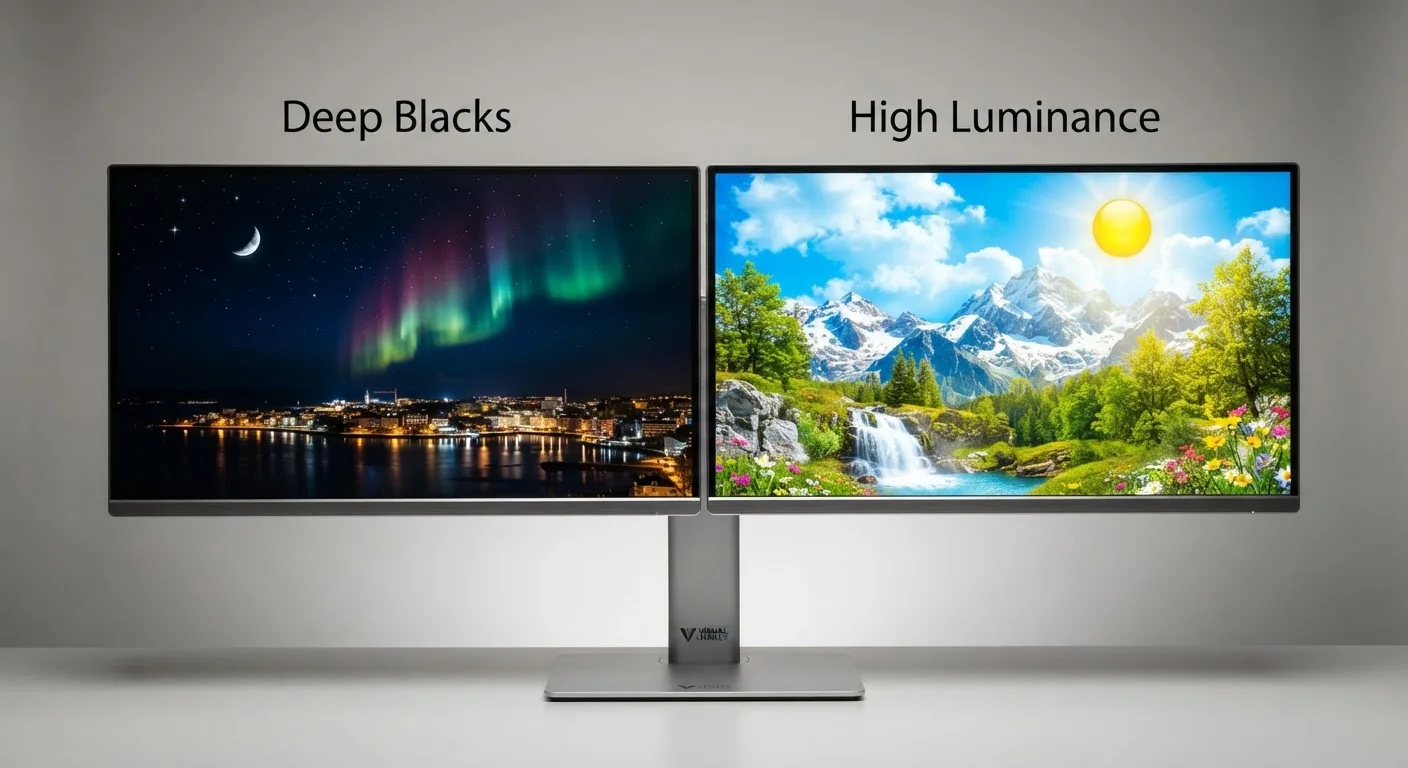
Photo: UltraSearches.com | Search Results You Can Trust editorial
Key Takeaways
- OLED pixels produce their own light and can switch off completely, delivering true black levels.
- QLED uses a quantum dot filter over an LCD backlight to enhance color volume and brightness.
- QLED panels generally reach higher peak brightness, making them better suited for well-lit rooms.
- OLED screens offer superior viewing angles and near-instant pixel response times.
- Both technologies support 4K resolution and HDR - the display type shapes how those specs are rendered.
The Core Technology Behind Each Panel
Understanding OLED and QLED starts with one fundamental question: where does the light come from?
OLED - Organic Light-Emitting Diode - uses organic compounds that emit light when electrical current passes through them. Every single pixel is its own independent light source. When a scene requires a black area, those pixels simply turn off entirely, producing the deepest possible black with no light bleed into surrounding areas. This is what gives OLED its signature infinite contrast ratio.
QLED - Quantum Light-Emitting Diode - is a refinement of standard LCD (Liquid Crystal Display) technology, not a fundamentally new panel type. A layer of quantum dots (nanoscale semiconductor particles) sits between the LCD panel and its backlight. When backlight photons pass through the quantum dot layer, those dots re-emit light at very precise, narrow wavelengths, producing more accurate and saturated colors than a conventional LCD. The result is a wider color gamut and improved brightness - but the underlying backlight is still present across the whole screen, which limits how dark blacks can get.
For a plain-language breakdown of related panel terms, see the Consumer Electronics Terminology Glossary.
| Criterion | OLED | QLED |
|---|---|---|
| Light source | Self-emissive pixels | LCD backlight + quantum dots |
| Black level | True black (pixel off) | Near-black (backlight present) |
| Peak brightness | Moderate to high | Very high |
| Contrast ratio | Effectively infinite | High, but limited by backlight |
| Viewing angle | Wide and consistent | Narrower; varies by panel type |
| Response time | Sub-millisecond | 1-5 ms typical |
| Burn-in risk | Present with static content | Not a known concern |
| Best environment | Dim or dark rooms | Bright or well-lit rooms |
Brightness, Contrast, and Real-World Picture Quality
These two technologies make different trade-offs between brightness and contrast - and your room environment largely determines which trade-off works better for you.
QLED panels can reach peak brightness levels that OLED currently struggles to match. Some QLED implementations achieve brightness figures well above 1,000 nits under highlight conditions, which translates to HDR content that feels genuinely luminous in a sunlit room. The trade-off is a contrast ceiling: because a backlight illuminates the whole panel, local dimming zones (used to approximate darker areas) cannot fully eliminate light bleed. Blacks appear dark gray rather than truly black under close inspection.
OLED's pixel-level control flips this equation. Its contrast performance is essentially unlimited - a bright star against a night sky is rendered with no glow around it. However, OLED panels historically produce lower sustained brightness, particularly over large bright areas, to manage heat and pixel longevity. Manufacturers have advanced this considerably, but a brightness gap still exists under certain conditions.
∞:1
OLED contrast ratio (theoretical)
Because individual pixels switch fully off, the measured contrast ratio is effectively infinite - no backlight contributes to black areas.
2,000+ nits
Peak brightness in high-end QLED panels
Select flagship QLED models are rated above 2,000 nits peak brightness, supporting demanding HDR highlight rendering in bright environments.
Both technologies support HDR (High Dynamic Range) standards, but how HDR is expressed differs. OLED uses contrast headroom to convey HDR impact; QLED uses luminance headroom. Our article on what HDR actually means goes deeper on how HDR interacts with panel performance.
Viewing Angles, Response Time, and Longevity
Beyond brightness and contrast, three practical factors often influence real-world satisfaction.
Viewing Angles
OLED panels emit light uniformly in all directions from each pixel. Color accuracy and brightness remain consistent whether you're sitting directly in front of the screen or at a significant horizontal angle. Most QLED panels use VA (Vertical Alignment) LCD technology, which narrows the sweet spot - colors can shift and brightness can drop noticeably when viewed off-axis. Some QLED models use IPS-type panels that improve this, though typically at the cost of some contrast.
Response Time
OLED pixels respond nearly instantaneously to electrical signals - response times are measured in fractions of a millisecond. This makes motion appear exceptionally clean with minimal blur or ghosting, a noticeable advantage for fast-motion sports and gaming content. QLED, like all LCD-based displays, requires physical liquid crystal realignment, which introduces more motion blur, though modern local dimming and processing have reduced this gap considerably.
Longevity and Burn-In Risk
Organic compounds in OLED pixels degrade over time, and prolonged display of static elements - channel logos, news tickers, navigation bars - can cause permanent image retention, known as burn-in. Manufacturers have introduced pixel-shifting and brightness management to mitigate this, and burn-in is rarely a problem in normal varied viewing habits. QLED panels do not face this risk, which may matter for users who display static content for extended periods each day.
Mini-LED and QD-OLED: Hybrid Approaches
The content on this site is for informational purposes only and is not a substitute for professional advice. Always consult a qualified professional for guidance specific to your situation.