
Wired vs. Wireless Headphones: What Changes Beyond the Cable

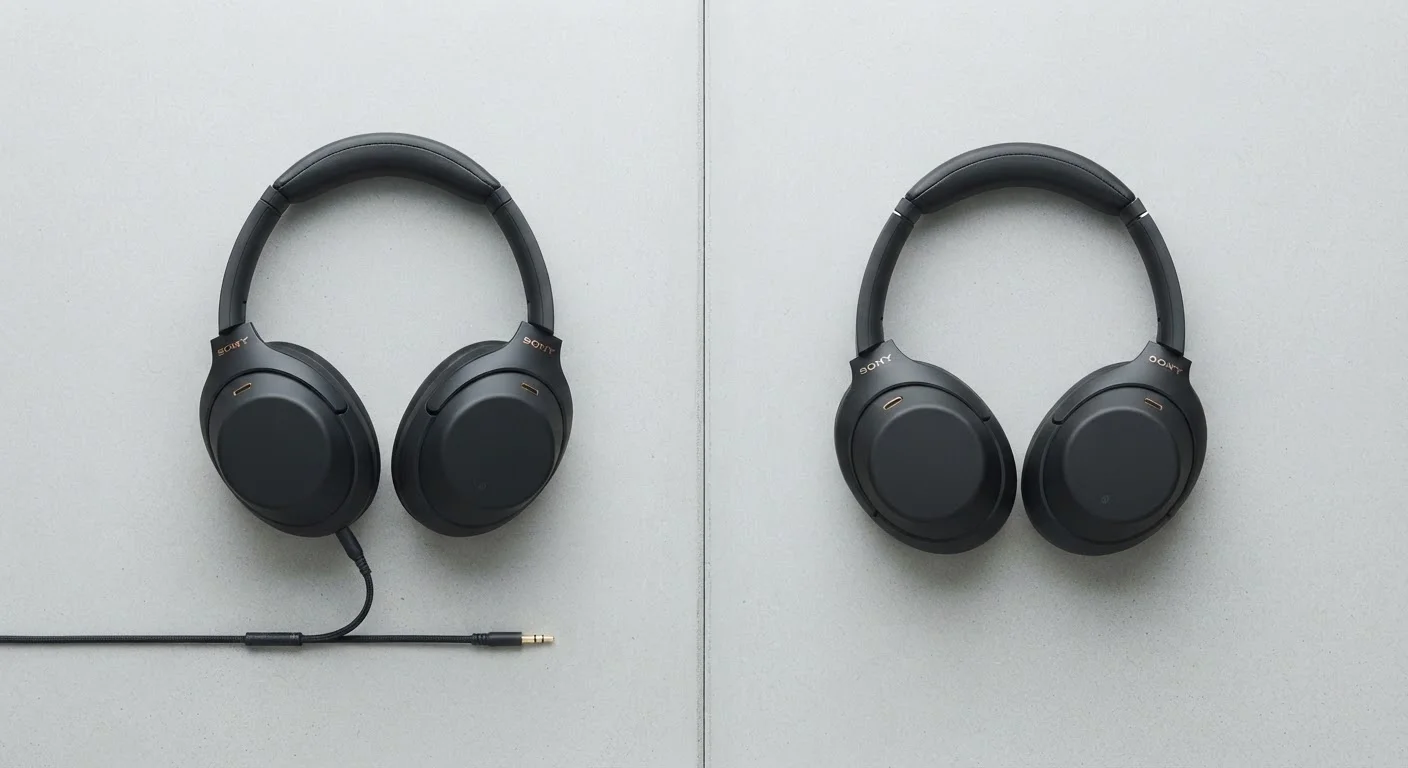
Photo: UltraSearches.com | Search Results You Can Trust editorial
Key Takeaways
- Wired headphones draw power directly from the source, eliminating battery management entirely.
- Wireless headphones use Bluetooth codecs to compress and transmit audio, introducing some signal processing.
- Latency is measurably lower with wired connections - a real concern for video sync and gaming.
- Modern wireless headphones can sound excellent for casual and even enthusiast listening.
- The right choice depends on your primary use case, not marketing claims about either format.
The Core Difference: How Audio Gets from Source to Ear
Wired headphones receive an analog electrical signal through a physical cable. That signal travels from your device's headphone jack or DAC (digital-to-analog converter) directly to the drivers in the ear cups - no encoding, no wireless transmission, no processing in between.
Wireless headphones receive a digital audio signal transmitted over Bluetooth. Before that transmission, the audio is encoded using a codec - a compression algorithm - and then decoded inside the headphone before playback. Common codecs include SBC, AAC, aptX, and Sony's LDAC. Each represents a different trade-off between audio quality, latency, and device compatibility. Understanding what those codec labels actually mean is useful before evaluating any wireless model.
This fundamental difference - analog direct versus digital wireless - is what drives nearly every practical distinction between the two formats.
Audio Fidelity: How Much Does It Actually Matter?
For many years, wired headphones held a clear advantage in audio quality. Analog transmission avoids the generational signal loss introduced by encoding and decoding, and wired connections can support higher-resolution audio formats without compression artifacts.
That gap has narrowed substantially. Higher-bandwidth codecs like LDAC can transmit audio at up to 990 kbps, supporting near-lossless quality over Bluetooth. For casual listening and music streaming - where the source audio is already compressed - this difference is rarely audible to most listeners.
Where wired connections still hold a practical edge is in professional or critical listening contexts: mixing, mastering, or audiophile use cases where every stage of the signal chain matters. For those applications, the absence of any wireless processing remains a real, not just theoretical, advantage.
990 kbps
Maximum LDAC Bluetooth bitrate
Sony's LDAC codec transmits at up to 990 kbps, compared to SBC's maximum of around 328 kbps, significantly narrowing the wireless audio quality gap.
40-200ms
Typical Bluetooth audio latency range
Latency varies widely by codec - aptX Low Latency targets under 40ms, while standard SBC can exceed 150ms, with real-world results varying by device pairing.
20-30 hrs
Typical wireless headphone battery life
Many current over-ear wireless models advertise 20 to 30 hours of playback per charge, though active noise cancellation typically reduces that figure.
Latency and Sync: The Hidden Practical Tradeoff
Latency - the delay between audio being sent and heard - is essentially zero with a wired connection. Bluetooth introduces latency that varies by codec and implementation, typically ranging from roughly 40ms to over 200ms depending on the codec and hardware.
For music listening, latency is irrelevant. For watching video or gaming, it can be very noticeable. Even a 100ms delay causes visible lip-sync drift in video. Some wireless headphones include a dedicated "low latency" or "game mode" that reduces delay, though often at the cost of audio quality. If video sync accuracy matters to you, wired remains the more dependable option.
| Criterion | Wired Headphones | Wireless Headphones |
|---|---|---|
| Audio transmission | Analog, direct | Digital, codec-compressed |
| Latency | Near zero | 40ms-200ms+ depending on codec |
| Battery required | No | Yes (typically 20-30 hrs) |
| Cable management | Required | None |
| Freedom of movement | Limited by cable length | Up to ~30 ft from source |
| Long-term durability | High (replaceable cable) | Battery degrades over time |
| Best audio fidelity ceiling | Higher (no codec loss) | Near-lossless with LDAC |
| Video/gaming sync | Reliable | Variable; mode-dependent |
Battery, Durability, and Long-Term Ownership
Wired headphones have no battery - they work as long as the cable and drivers are intact. This simplicity translates to fewer failure points and potentially longer usable lifespans. Cables can be replaced; the headphone itself often lasts for years without degradation.
Wireless headphones introduce a battery that degrades over charge cycles. Most current models deliver 20-30 hours of playback per charge, which is more than adequate for most users. However, after several hundred charge cycles, capacity will diminish - eventually to the point where it limits usability. Some models allow battery replacement; many do not.
Battery Replaceability Varies by Model
The practical implication: wireless headphones have a finite battery lifespan that wired headphones simply don't. This matters most if you plan to keep a pair for many years or use them heavily every day.
The content on this site is for informational purposes only and is not a substitute for professional advice. Always consult a qualified professional for guidance specific to your situation.