
HMO, PPO, EPO, and HDHP: What Sets Each Plan Type Apart

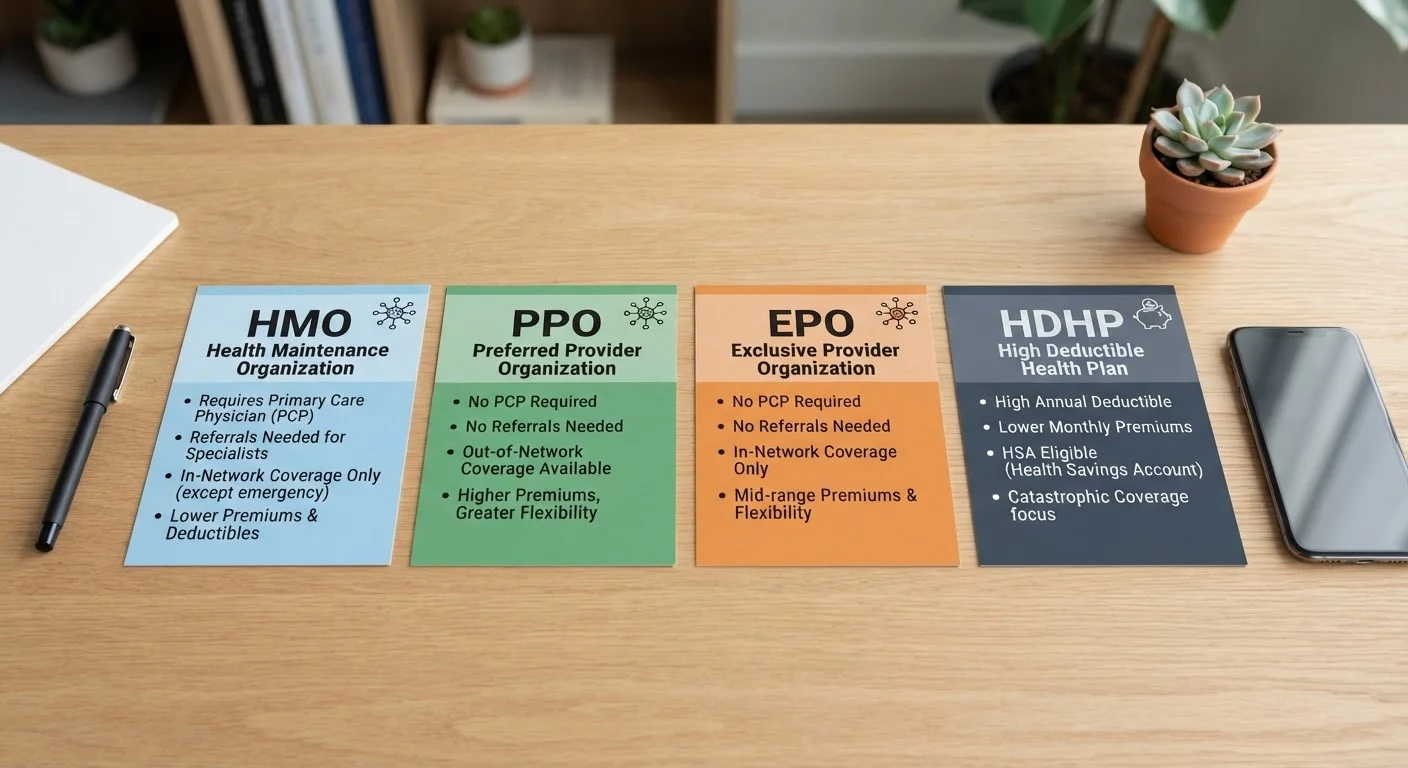
Photo: UltraSearches.com | Search Results You Can Trust editorial
Key Takeaways
- HMOs require you to use a specific network and get referrals to see specialists.
- PPOs offer the most flexibility but typically carry higher premiums.
- EPOs combine network restrictions with no referral requirement - a middle-ground structure.
- HDHPs pair lower premiums with higher deductibles and qualify you for a Health Savings Account (HSA).
- No single plan type is universally better - the right fit depends on your health use patterns and finances.
Why Plan Structure Matters Before Anything Else
When comparing health plans, most people focus immediately on premiums - the monthly cost of coverage. But the plan type (its structural design) determines how you access care, whether referrals are required, how far your coverage extends, and how costs are distributed between you and the insurer. Two plans with identical premiums can deliver very different experiences depending on their structure.
The four plan types discussed here - HMO (Health Maintenance Organization), PPO (Preferred Provider Organization), EPO (Exclusive Provider Organization), and HDHP (High-Deductible Health Plan) - represent the dominant structures offered through employer benefits and the individual marketplace. For a grounding in the terminology that applies across all of them, see Health Insurance Decoded.
| HMO | PPO | EPO | HDHP | |
|---|---|---|---|---|
| Network restriction | In-network only | In- and out-of-network | In-network only | Varies by underlying plan |
| Primary care physician required | Yes | No | No | Depends on plan |
| Referrals to see specialists | Required | Not required | Not required | Depends on plan |
| Typical premium level | Lower | Higher | Moderate | Lower |
| Deductible level | Moderate | Moderate to high | Moderate | High (IRS-defined minimum) |
| HSA eligibility | No | No | No | Yes |
| Out-of-network emergency coverage | Generally yes | Yes | Generally yes | Depends on plan |
HMO: Coordinated Care Within a Defined Network
An HMO ties your coverage to a specific network of doctors, hospitals, and other providers. To use plan benefits, you must receive care from in-network providers - with very limited exceptions for genuine emergencies. You are also required to choose a primary care physician (PCP), who becomes your central point of contact and must issue referrals before you can see a specialist.
This coordination model is deliberate: it allows insurers to manage care pathways and costs more tightly, which is why HMOs generally carry lower premiums and lower out-of-pocket costs than PPOs. The tradeoff is reduced flexibility. If your preferred specialist is out-of-network, you will typically pay the full cost yourself unless the plan grants a narrow exception.
HMOs tend to suit people who have an established relationship with in-network providers, prefer lower and more predictable costs, and are comfortable having their care coordinated through a single primary physician.
Check the Network Before You Enroll
PPO: Flexibility at a Higher Price
A PPO gives you the freedom to see any licensed provider - in-network or out-of-network - without a referral. In-network visits are covered at a higher benefit rate, but out-of-network care is still partially covered (rather than excluded entirely). There is no PCP requirement, meaning you can book directly with a specialist whenever you choose.
This flexibility comes at a cost. PPO premiums are typically higher than HMO premiums, and out-of-network cost-sharing (your portion of the bill) can be substantial. You may also face separate deductibles for in-network and out-of-network services, so it pays to read the plan's summary of benefits carefully.
PPOs are a natural fit for people who manage ongoing or complex conditions requiring multiple specialists, live in areas where provider networks are thin, or simply place a high value on direct access to any provider they choose.
EPO: Network-Only Coverage Without the Referral Requirement
An EPO is essentially a hybrid: it combines the network restriction of an HMO (no meaningful out-of-network coverage) with the self-referral freedom of a PPO (no PCP gatekeeper). You can see any in-network specialist directly, but if you step outside the network for non-emergency care, you bear the full cost yourself.
EPO premiums typically fall between HMO and PPO rates. For people who are comfortable staying within a network but find the referral process cumbersome, an EPO can be an efficient structure. However, the absence of out-of-network coverage is a meaningful limitation if you travel frequently or live in an area where the plan's network is narrow.
Before enrolling in an EPO, confirm that your current providers - especially any specialists you see regularly - are included in the plan's network. Because there is no out-of-network safety net, a provider gap has direct financial consequences. Use this plan-switching checklist to verify provider access before you commit.
HDHP: Lower Premiums, Higher Cost Exposure, and HSA Eligibility
An HDHP is defined by its deductible - the amount you must pay out of pocket before most insurance benefits kick in. The IRS sets minimum thresholds that qualify a plan as an HDHP; these thresholds are updated periodically and apply to both individual and family coverage tiers. Because enrollees absorb more initial cost, insurers charge lower monthly premiums.
The notable advantage of an HDHP is Health Savings Account (HSA) eligibility. An HSA is a tax-advantaged account you can fund to pay qualified medical expenses - contributions reduce taxable income, growth is tax-free, and withdrawals for eligible costs are also tax-free. No other plan type unlocks this triple tax benefit.
HDHPs are most advantageous for people in generally good health who do not anticipate significant medical spending, have the financial cushion to absorb a higher deductible in a difficult year, and want to systematically build tax-sheltered savings for future healthcare costs. They require honest self-assessment: the lower premium is only a true saving if your actual care costs don't regularly exceed what you'd spend under a higher-premium plan. For a deeper look, see The Tradeoffs of High-Deductible Health Plans.
58%
Employer-sponsored enrollees in PPO plans
According to KFF's Employer Health Benefits Survey, PPOs consistently attract the largest share of covered workers among plan types.
29%
Employer-sponsored enrollees in HDHP/SO plans
KFF data shows HDHP enrollment with a savings option has grown significantly over the past decade among workers with employer coverage.
Choosing Based on Your Actual Situation
The most common mistake in plan selection is choosing based on premium alone. A more reliable approach is to estimate your expected care use for the coming year - routine visits, prescriptions, specialist needs - and model total annual cost (premium plus likely out-of-pocket) under each plan type available to you.
Other practical factors include: whether your current doctors are in-network, whether you need coordinated care for a chronic condition, how often you travel, and whether an HSA fits your financial planning goals. If you're approaching open enrollment, this open enrollment walkthrough steps through this comparison process in detail.
All four plan types must cover the ten categories of essential health benefits required under federal law. For a breakdown of what that coverage actually includes, see everything covered under the ACA's essential health benefits.
This article is for general informational and educational purposes only and does not constitute personalized insurance, financial, or legal advice. Coverage terms, network structures, and costs vary by plan and provider. Always review your plan's Summary of Benefits and Coverage and consult a licensed insurance professional before making enrollment decisions.
The content on this site is for informational purposes only and is not a substitute for professional advice. Always consult a qualified professional for guidance specific to your situation.