
In-Network vs. Out-of-Network: Why the Distinction Costs People Money

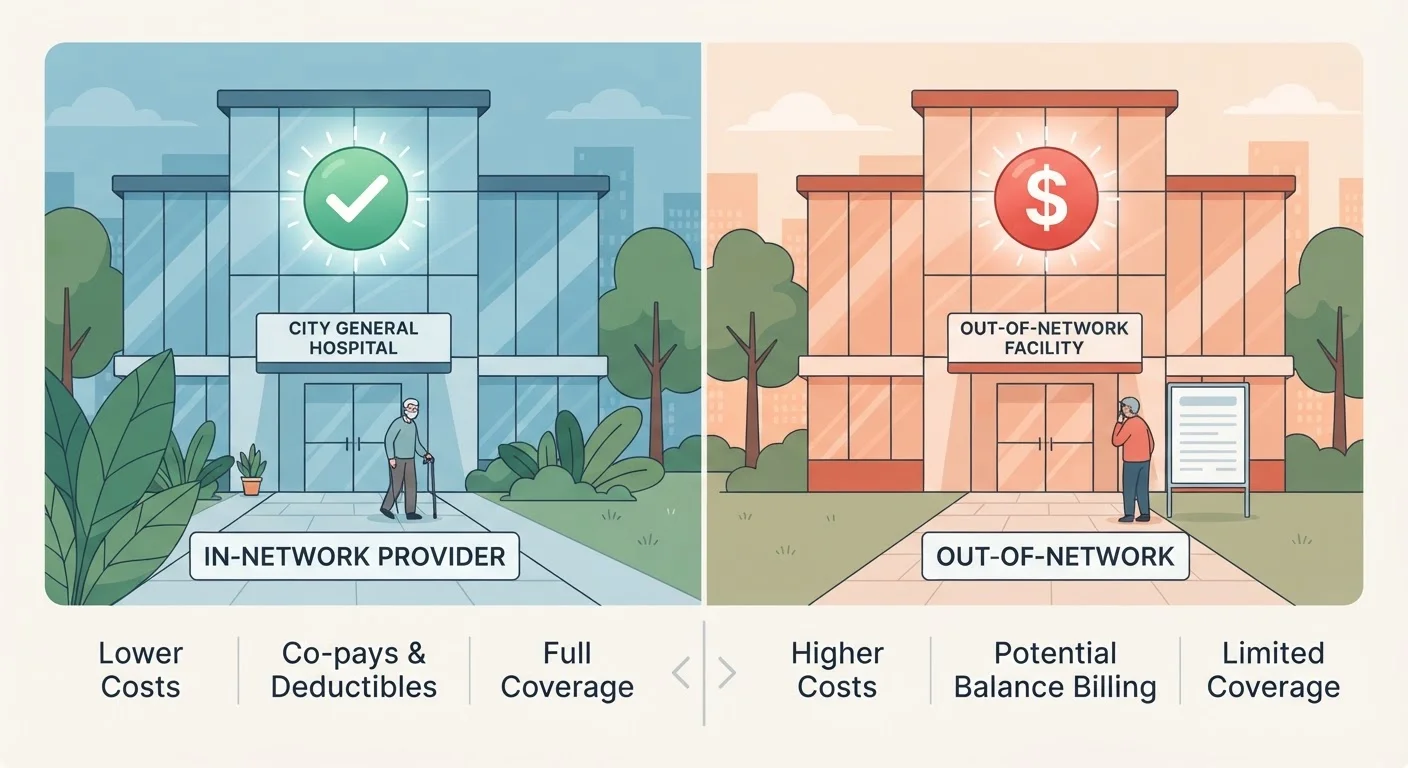
Photo: UltraSearches.com | Search Results You Can Trust editorial
Key Takeaways
- In-network providers have negotiated rates with your insurer, which directly reduces your out-of-pocket costs.
- Out-of-network care often comes with a separate, higher deductible and no out-of-pocket maximum protection on some plans.
- Balance billing - being charged the gap between a provider's rate and what your insurer pays - is a real risk with out-of-network care.
- Confirming a provider's network status before your visit is essential; online directories can be outdated.
- HMO plans typically offer no out-of-network coverage at all, while PPO plans offer some at a higher cost.
How Provider Networks Actually Work
Health insurance plans don't simply pay any provider whatever they charge. Instead, insurers establish networks - groups of doctors, hospitals, labs, and other providers who have signed contracts agreeing to accept a negotiated rate for covered services. That negotiated rate is almost always lower than what the provider would charge without an agreement.
When you see a provider inside your plan's network, your insurer pays its share of that pre-agreed rate, and you pay yours - typically a copay (a fixed dollar amount) or coinsurance (a percentage of the negotiated cost). Both figures are defined in your plan's Summary of Benefits and Coverage.
When you see a provider outside that network, there's no agreed-upon rate. Your insurer may pay a limited amount based on what it considers a "usual, customary, and reasonable" (UCR) fee, and you could be responsible for the rest - including a separate, higher deductible and the provider's full charges above what the insurer covers.
Understanding this structure is a prerequisite for making sense of your Explanation of Benefits (EOB) after a claim. For a deeper look at how plan costs layer together, see how premiums, subsidies, and costs connect.
| Criterion | In-Network Provider | Out-of-Network Provider |
|---|---|---|
| Pricing | Negotiated rate with insurer | Provider's standard (often higher) charges |
| Deductible | Standard plan deductible applies | Often a separate, higher deductible |
| Coinsurance | Lower percentage (e.g., 20%) | Higher percentage (e.g., 40-50%) |
| Out-of-pocket maximum | Costs count toward OOP max | May not count toward OOP max |
| Balance billing risk | None - rate is pre-agreed | Possible - gap between UCR and charges |
| HMO / EPO coverage | Fully covered per plan terms | Generally not covered (emergencies excepted) |
| PPO coverage | Covered at preferred rate | Covered at reduced rate with higher cost-share |
The Real Cost Differences - and the Balance Billing Risk
The financial gap between in-network and out-of-network care can be substantial, and it shows up in several ways.
- Separate deductible: Many plans maintain a distinct, higher deductible for out-of-network services. You may have already met your in-network deductible for the year and still owe a full out-of-network deductible from scratch.
- No out-of-pocket maximum protection: On some plan types, out-of-network costs don't count toward your plan's out-of-pocket maximum, meaning your exposure is theoretically unlimited.
- Balance billing: This is the biggest surprise for many patients. If a provider charges $500 for a service and your insurer's UCR rate is $300, the insurer might pay $240 (its 80% share). You'd owe your coinsurance on $300 - but the provider can also bill you the remaining $200 gap. That's called balance billing, and it's legal in many circumstances.
The federal No Surprises Act, which took effect in 2022, offers some protections - particularly for emergency care and situations where an out-of-network provider treats you at an in-network facility without your knowledge. However, these protections have limits and don't cover all scenarios. Reading your plan documents and knowing your rights matters here.
1 in 5
Emergency visits involving an out-of-network charge
Research published in Health Affairs found roughly one in five emergency department visits resulted in at least one out-of-network charge, even when the hospital itself was in-network.
~$750
Median surprise bill amount for emergency care
A Kaiser Family Foundation analysis estimated median surprise medical bills of several hundred dollars per incident, with some reaching thousands depending on the service.
This cost structure is also relevant when evaluating plan types. High-deductible health plans often have narrower networks, so out-of-network exposure can be especially significant for enrollees in those plans.
How to Check Network Status Before Your Visit
Confirming whether a provider is in-network is a step many people skip - often because they assume their regular doctor is covered, or because they trust a referral without verifying. Both assumptions carry risk.
- Use your insurer's online directory: Every health plan is required to maintain a provider directory. Search by the provider's name, specialty, or location. However, note that directories can be outdated - providers leave networks, and some directories lag by months.
- Call the provider's billing office: Ask specifically whether the provider accepts your insurance plan and your specific plan network (for example, a physician may be in a national PPO network but not in your employer's narrow-network variant).
- Call your insurer directly: Your member services number is on your insurance card. A representative can confirm in real time whether a specific provider's NPI (National Provider Identifier) is contracted under your plan.
- Get it in writing when possible: For non-emergency procedures, request written confirmation of network status. If a billing error occurs later, documentation supports your appeal.
Being proactive is especially important around specialist referrals and hospital-based providers. Even when a hospital is in-network, individual physicians working there - such as anesthesiologists or radiologists - may not be. This is a common source of surprise bills. For a broader look at the assumptions that lead to unexpected charges, see common costly insurance mistakes.
When you're selecting a plan during open enrollment, checking whether your existing providers are in-network should be a top priority before comparing premiums. A practical open enrollment walkthrough can help you approach that process systematically.
Plan Type Determines Your Out-of-Network Options
This article is for general informational purposes only and does not constitute insurance, legal, or financial advice. Coverage terms, network rules, and regulations vary by plan and state. Always read your plan documents carefully and consult a licensed insurance professional for guidance specific to your situation.
The content on this site is for informational purposes only and is not a substitute for professional advice. Always consult a qualified professional for guidance specific to your situation.