
Roundabouts vs. Traditional Intersections: Which Is Safer and Why

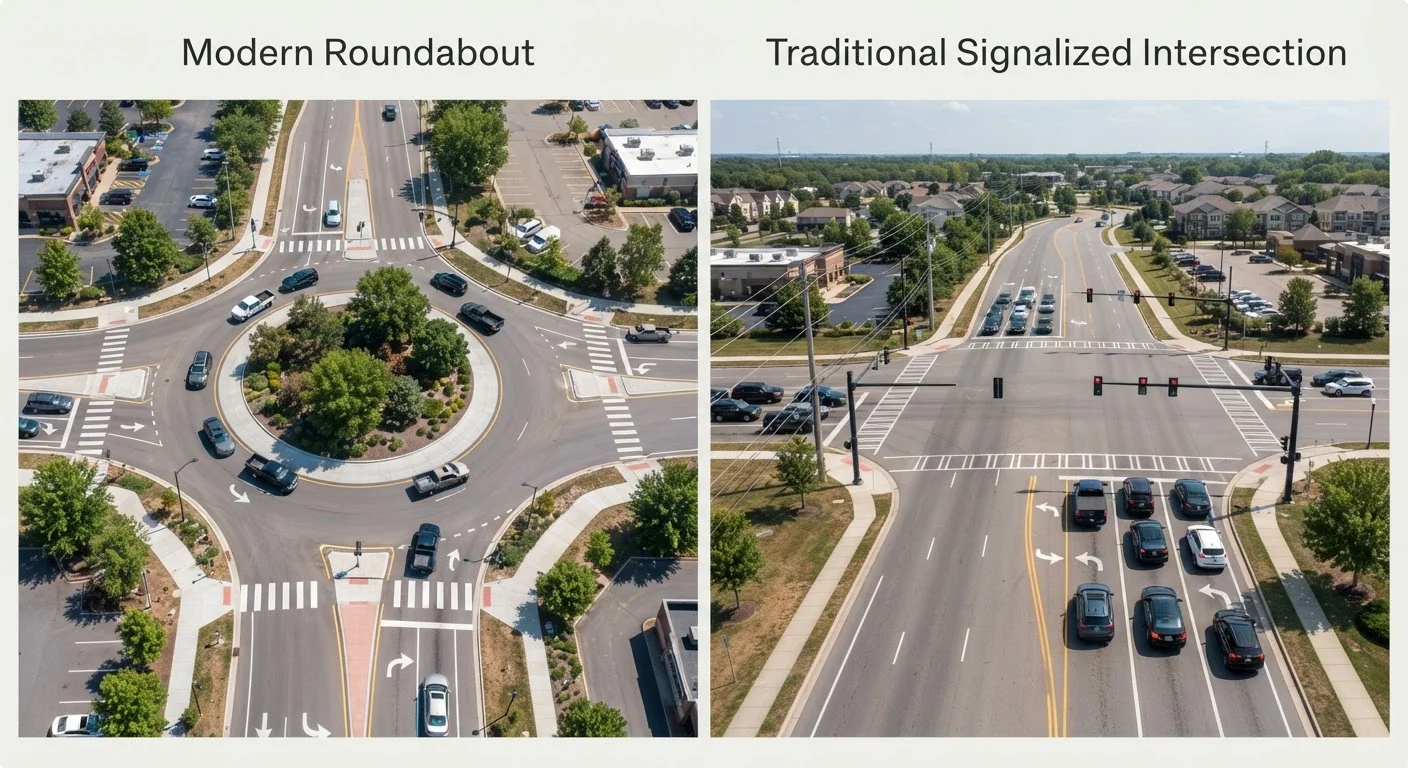
Photo: UltraSearches.com | Search Results You Can Trust editorial
Key Takeaways
- Roundabouts eliminate the crossing-path conflicts responsible for the most fatal intersection crashes.
- The Federal Highway Administration links roundabouts to roughly 90% fewer fatal crashes than signalized intersections at the same site.
- Entry speeds at roundabouts are typically 15-25 mph, reducing collision force compared to signal-controlled approaches.
- Pedestrians at roundabouts cross shorter, one-direction traffic streams, but must navigate without the signal cues they rely on at traditional intersections.
- Traditional intersections handle high-volume, complex traffic patterns more predictably for unfamiliar drivers.
- Neither design eliminates risk entirely - driver behavior remains the decisive safety variable at any intersection.
How Each Design Manages Conflict Points
Every intersection is fundamentally a problem of conflict points - places where vehicle paths can cross, merge, or diverge. A conventional four-way signalized intersection creates up to 32 vehicular conflict points. A single-lane roundabout reduces that number to 8, and critically, it eliminates the right-angle crossing conflicts that produce the most destructive crashes.
At a traditional intersection, a driver who runs a red light or misjudges a gap faces a broadside or head-on collision at whatever speed both vehicles were traveling. At a roundabout, all traffic moves in one direction around a central island, so the geometry itself prevents those crossing paths from existing. Any collision that does occur is more likely to be a sideswipe or a low-speed merge conflict - far less lethal by nature.
The Federal Highway Administration (FHWA) has documented that converting a traditional intersection to a roundabout can reduce fatal crashes by approximately 90% and injury crashes by roughly 75% at that location. These figures come from before-and-after studies at converted sites, not theoretical models. Road safety in the U.S. involves many variables, but intersection design is one engineers can directly control.
| Criterion | Roundabouts | Traditional Signalized Intersections |
|---|---|---|
| Vehicular conflict points | 8 (single-lane) | Up to 32 |
| Fatal crash reduction (converted sites) | ~90% fewer (FHWA data) | Baseline |
| Typical entry speed | 15-25 mph | Up to posted arterial speed |
| Right-angle collision risk | Eliminated by geometry | Present; depends on compliance |
| Pedestrian crossing clarity | Less structured; shorter crossing | Protected signal phases available |
| Driver familiarity (U.S.) | Lower; adaptation curve exists | High; decades of conditioning |
| High-volume throughput | Limited at single-lane designs | Well-suited with signal timing |
| Power/infrastructure dependency | None; functions during outages | Requires power; outages create risk |
Speed, Severity, and What Happens When Something Goes Wrong
Crash severity is not just about whether a crash occurs - it's about how much kinetic energy is involved. Roundabouts enforce a natural speed reduction: drivers must slow to negotiate the curve, typically entering at 15-25 mph. At a signalized intersection, vehicles may be traveling at 40-50 mph when they enter the crossing zone, especially on arterial roads.
Physics makes this consequential. Crash energy increases with the square of speed, so a collision at 40 mph releases roughly four times the energy of one at 20 mph. Lower entry speeds at roundabouts directly translate to reduced injury severity when crashes do happen.
~90%
Reduction in fatal crashes at converted roundabout sites
According to Federal Highway Administration before-and-after studies of intersections converted from traditional signals to roundabouts.
8 vs. 32
Conflict points: roundabout vs. four-way intersection
A single-lane roundabout has 8 potential vehicular conflict points compared to up to 32 at a conventional four-way signalized intersection.
~75%
Reduction in injury crashes at converted sites
FHWA research indicates injury crashes - not just fatalities - drop significantly when signalized intersections are converted to roundabouts.
That said, roundabouts introduce real challenges for some road users. Pedestrians lose the clear protected signal phase they rely on at traditional intersections. Drivers with visual impairments face a less structured environment. Cyclists, depending on the design, may feel exposed while navigating circulating lanes. These are genuine trade-offs, not minor footnotes - and they explain why not every intersection is an automatic candidate for conversion. For drivers looking to develop better situational awareness at any intersection type, defensive driving habits remain the most transferable skill.
Driver Familiarity, Confusion, and the Adaptation Curve
American drivers have had far less exposure to roundabouts than their counterparts in the United Kingdom or Australia, where the design is standard. Unfamiliarity breeds hesitation and error - studies have found that wrong-way entries and yield violations are more common at newly opened roundabouts than at established ones. This suggests a genuine adaptation curve rather than a permanent safety penalty.
Traditional intersections benefit from decades of driver conditioning. Most U.S. drivers understand signal phases intuitively, know how to handle left-turn arrows, and can navigate a four-way stop under pressure. That familiarity has real safety value, particularly for older drivers, teen drivers, and anyone in an unfamiliar vehicle.
Roundabout confusion tends to cluster around two behaviors: failure to yield to circulating traffic at entry, and uncertainty about which lane to use in multi-lane roundabouts. Single-lane roundabouts sidestep the lane-choice problem entirely, which is one reason transportation engineers often recommend them as the first-choice design when traffic volumes allow. Understanding how posted speed limits relate to safe approach speeds is especially relevant when approaching an unfamiliar roundabout for the first time.
Multi-Lane Roundabouts Are a Different Story
This article is for general informational purposes only and does not constitute engineering, legal, or personalized safety advice. Intersection design decisions involve local traffic studies and regulatory review by qualified professionals.
The content on this site is for informational purposes only and is not a substitute for professional advice. Always consult a qualified professional for guidance specific to your situation.