
Speed Limits vs. Safe Speed: Why the Posted Number Isn't Always Enough

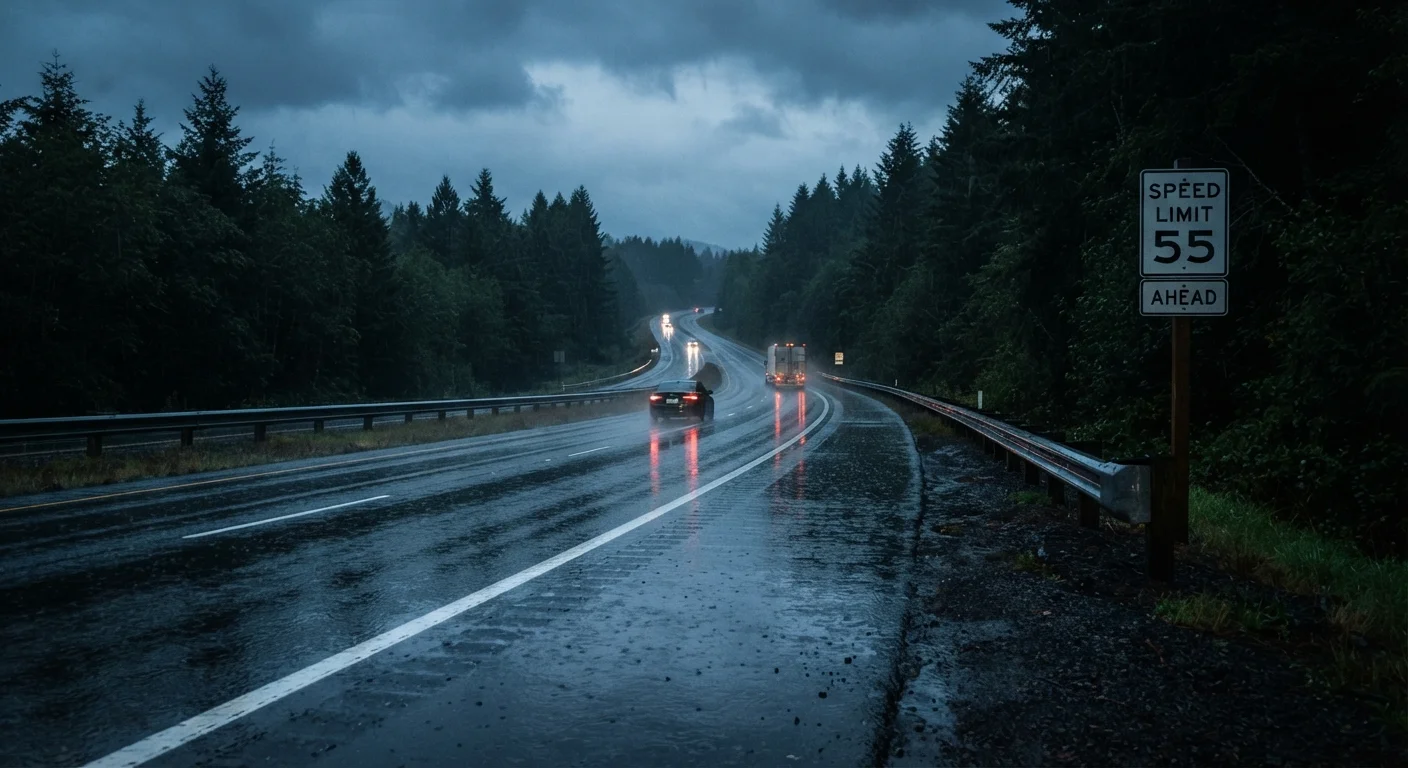
Photo: UltraSearches.com | Search Results You Can Trust editorial
Key Takeaways
- Posted speed limits are legal maximums for ideal conditions, not universal safety targets.
- Stopping distance increases dramatically with speed - even modest increases have outsized effects.
- Rain, fog, ice, heavy traffic, and curves all demand speeds well below the posted limit.
- Most U.S. states enforce a 'basic speed law' requiring drivers to travel at a speed that is reasonable given conditions.
- Driving at the speed limit while conditions are poor can still result in a citation or liability.
What Speed Limits Are - and What They Are Not
Speed limits are established through traffic engineering studies that evaluate road geometry, typical traffic volumes, and surrounding land use under normal, favorable conditions. They set a legal maximum, not a guaranteed safe speed for every situation a driver might encounter.
Most U.S. states codify this distinction through what is commonly called the basic speed law - a statute requiring drivers to operate at a speed that is reasonable and prudent given existing conditions, regardless of what the sign says. That means driving at 55 mph on a 55 mph road can still be unlawful, and more importantly unsafe, when visibility is near zero or the road is iced over.
Understanding this distinction is foundational to defensive driving - the recognition that legal compliance and actual safety are related but not identical concepts.
| Criterion | Posted Speed Limit | Safe Speed |
|---|---|---|
| Defined by | Traffic engineering studies | Real-time conditions and driver judgment |
| Legal status | Statutory maximum | Required under basic speed laws in most states |
| Assumes | Ideal road and weather conditions | Actual visibility, traction, and traffic |
| Changes with conditions | No - fixed on the sign | Yes - continuously adjusted by driver |
| Accounts for stopping distance | At baseline only | Fully, including surface and visibility factors |
| Liability if a crash occurs | Speed limit compliance alone may not absolve fault | Demonstrating reasonable speed for conditions reduces fault risk |
The Physics of Stopping Distance
Speed's relationship to stopping distance is not linear - it is exponential. Doubling your speed roughly quadruples the distance required to stop. At 30 mph on a dry road, a typical passenger vehicle needs approximately 75 feet to stop after the driver perceives a hazard and brakes. At 60 mph, that figure climbs to around 240 feet.
~240 ft
Stopping distance at 60 mph on dry pavement
Federal Highway Administration data estimates total stopping distance (perception + braking) for a typical passenger vehicle at approximately 240 feet at 60 mph under dry conditions.
50%+
Increase in stopping distance on wet roads
The National Highway Traffic Safety Administration notes that wet pavement can extend stopping distances by more than 50% compared to dry conditions, varying by tire tread depth.
~1.5 sec
Average driver perception-reaction time
Traffic engineering standards commonly use 1.5 seconds as the baseline perception-reaction time for an alert, unimpaired driver in familiar surroundings.
Wet pavement can increase stopping distance by 50% or more. Ice can multiply it by four to ten times, depending on tire condition and temperature. These are not worst-case outliers - they are common American driving conditions for much of the year in many states.
The implication is direct: a driver traveling at the posted limit on a slick road may have zero ability to stop before reaching a hazard that a lower speed would have made survivable. Nighttime driving compounds this further, since headlights typically illuminate only 160-250 feet ahead - well short of stopping distance at highway speeds.
Conditions That Demand a Speed Reduction
Several recurring scenarios routinely call for speeds meaningfully below the posted limit:
- Rain and standing water: Hydroplaning can occur at speeds as low as 35 mph on worn tires. Reduce speed and increase following distance well before roads become visibly wet.
- Fog or smoke: If visibility drops below the distance required to stop, you are effectively driving blind. Reduce speed until you can see far enough ahead to respond to hazards.
- Snow and ice: Even all-wheel-drive vehicles do not stop faster on ice. Traction controls acceleration, not braking. Treat icy roads as a fundamentally different driving environment.
- Heavy traffic: Reaction time is fixed at roughly 1.5 seconds for most drivers. In dense traffic, a lower speed gives you - and vehicles around you - more room to react to chain-reaction events.
- Work zones and school zones: Reduced lane widths, unpredictable pedestrian movement, and distracted workers make these zones genuinely high-risk. See rules specific to these environments for state-by-state guidance.
- Sharp curves: Roads post advisory speeds on curves for a reason - centrifugal force pushes vehicles toward the outside of a turn, and that force increases with the square of speed.
Speed adjustments in these situations are not timid driving - they are a direct application of physics and probability to the task of arriving safely.
Advisory Speed Signs vs. Regulatory Speed Limits
Applying This in Everyday Driving
Bridging the gap between posted limits and safe speed requires a continuous habit of reading conditions rather than treating the speed limit sign as a set-and-forget instruction. A few practical approaches:
- Scan further ahead. The earlier you spot a potential hazard, the more time you have to reduce speed without hard braking. Most drivers focus 2-3 seconds ahead; doubling that window significantly improves reaction time.
- Adjust following distance first. Before reducing speed, increase your gap to the vehicle ahead. This alone buys reaction time and reduces the severity of a rear-end collision.
- Use speed as a response to conditions, not habit. If you are driving the same speed in a downpour as on a clear afternoon, the environment has changed but your behavior has not - that mismatch is where crashes originate.
For a broader framework on reading road environments, understanding what road signs communicate is a useful complement to speed awareness. Highway-specific hazards - where speed differentials between vehicles tend to be highest - are worth reviewing separately.
This article is for general informational purposes only. Traffic laws vary by state; consult your state's driver handbook or a qualified legal professional for guidance specific to your jurisdiction.
The content on this site is for informational purposes only and is not a substitute for professional advice. Always consult a qualified professional for guidance specific to your situation.