
Financing a Car Through a Dealership vs. a Bank or Credit Union

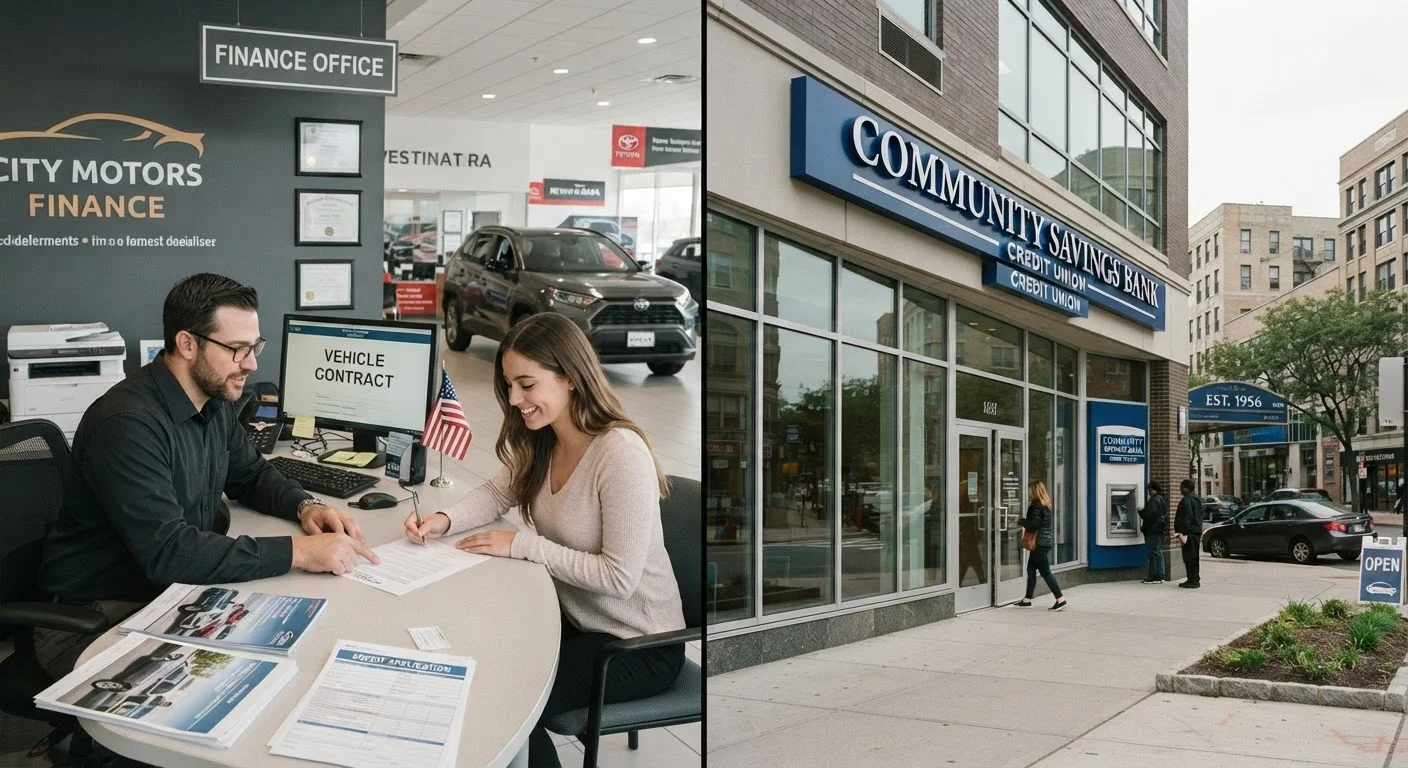
Photo: UltraSearches.com | Search Results You Can Trust editorial
Key Takeaways
- Dealership financing is convenient but may carry a markup over the lender's base rate, increasing total interest paid.
- Pre-arranged bank or credit union loans let you negotiate vehicle price and financing independently.
- Credit unions often offer lower APRs than banks or dealerships, especially for members with strong credit histories.
- Manufacturer-sponsored promotional rates (e.g., 0% APR) through dealerships can be genuinely competitive - but eligibility is typically strict.
- Shopping multiple lenders before visiting a dealership gives you a benchmark rate to compare against dealer offers.
- Loan term length, not just APR, significantly affects total cost - longer terms reduce monthly payments but increase interest paid overall.
How Each Financing Route Works
When you finance a vehicle through a dealership, the dealer acts as an intermediary between you and a third-party lender - typically a bank or captive finance company (the automaker's own lending arm). You complete a credit application at the dealership, and the finance office sources a loan on your behalf, often from multiple lenders simultaneously. The dealer then presents you with loan terms, which may include a markup above the lender's base rate - a practice sometimes called the "dealer reserve." This spread is legal in the United States, though disclosure requirements vary by state.
Direct lending - going to a bank or credit union before or independently of the dealership - flips this dynamic. You apply for a loan directly, receive a pre-approval letter specifying a maximum loan amount and interest rate, and bring that commitment to the dealership like cash. The lender funds the loan directly; no dealer intermediary takes a cut of the financing margin.
Understanding these structural differences matters before you sign anything. For a deeper breakdown of the loan language you'll encounter either way, see vehicle financing terms explained.
| Criterion | Dealership Financing | Bank or Credit Union Financing |
|---|---|---|
| Application process | Single application at point of sale | Apply directly with lender beforehand |
| Rate transparency | Dealer may mark up lender's base rate | Rate quoted directly - no intermediary markup |
| Promotional rates | Manufacturer 0%-low APR offers available | No manufacturer promotions; market rates apply |
| Negotiation dynamic | Price and financing bundled together | Price and financing negotiated separately |
| Speed and convenience | Complete purchase in one visit | Requires separate lender application step |
| Credit union option | Not available through dealership channel | Credit unions often offer lowest average APRs |
| Thin or imperfect credit | Access to multiple lenders via dealer network | Single lender decision; may be declined |
Interest Rates, Promotional Offers, and Real-World Costs
The rate you pay isn't determined solely by which channel you use - your credit score, loan term, vehicle age, and down payment all factor in. That said, the channel does create structural rate differences worth understanding.
Banks set rates based on creditworthiness and market conditions. Credit unions, being member-owned nonprofits, historically offer lower average APRs than commercial banks on auto loans, according to data regularly published by the National Credit Union Administration (NCUA). Dealership rates reflect whatever the lender charges plus any markup the finance office adds.
The notable exception is manufacturer promotional financing - offers like 0% APR or 1.9% for 60 months funded by the automaker's captive lender. These can be genuinely competitive, but they usually require excellent credit and may be offered in lieu of a cash rebate. Running the math on both scenarios (low rate vs. cash rebate plus bank financing) is worth the effort before committing.
~1-3%
Typical dealer reserve markup range on auto loans
The Consumer Financial Protection Bureau (CFPB) has documented that dealer interest rate markups commonly range from roughly 1 to 3 percentage points above the lender's buy rate, though this varies by lender policy and state regulation.
Lower avg. APR
Credit unions vs. banks on new auto loans
NCUA aggregate data has consistently shown credit unions offering lower average interest rates on new and used auto loans compared to commercial banks, though individual results depend on creditworthiness.
72-84 months
Share of new auto loans with extended terms rising
Industry data from sources including Experian's State of the Automotive Finance Market reports have shown growing proportions of buyers selecting loan terms of 72 months or longer, increasing total interest paid over the life of the loan.
Loan term is an equally important cost variable. A lower monthly payment on a 72- or 84-month loan may look attractive, but the additional interest paid over a longer term can add up substantially. This is true regardless of which financing channel you choose.
Negotiation Dynamics and Practical Trade-Offs
One underappreciated benefit of pre-arranging financing is negotiating clarity. When a dealership controls both the vehicle price and the financing conversation, it becomes easier to obscure the total cost of a deal by adjusting monthly payments rather than transparent line-item pricing. A buyer focused only on "what can I afford per month" may end up with a longer loan term, a higher rate, or both.
Arriving with a pre-approval transforms the conversation. The vehicle price becomes a separate negotiation from the financing terms, and you have a concrete benchmark APR to compare against anything the dealer's finance office presents. If the dealer can legitimately beat your pre-approved rate - which sometimes happens - you benefit. If they cannot, you use your pre-approval.
This dynamic is relevant whether you're buying new or used. For context on how vehicle type affects financing considerations, learn how new, used, and CPO vehicles differ in terms of pricing and warranties. Similarly, if a trade-in is part of your transaction, keeping that negotiation separate from financing is equally useful - see private sale vs. trade-in trade-offs.
Rate Shopping Doesn't Have to Hurt Your Credit
This article provides general financial education about auto loan structures and is not personalized financial or lending advice. Rates, eligibility, and terms vary by lender, credit profile, and state. Consult a licensed financial professional or compare multiple lenders directly before making a borrowing decision.
This article is for general informational purposes only and does not constitute financial, legal, or lending advice. Loan terms, interest rates, and lender availability vary. Readers should compare lenders directly and consult a qualified financial adviser for guidance specific to their situation.
The content on this site is for informational purposes only and is not a substitute for professional advice. Always consult a qualified professional for guidance specific to your situation.