
What the Numbers on a Speaker Really Tell You

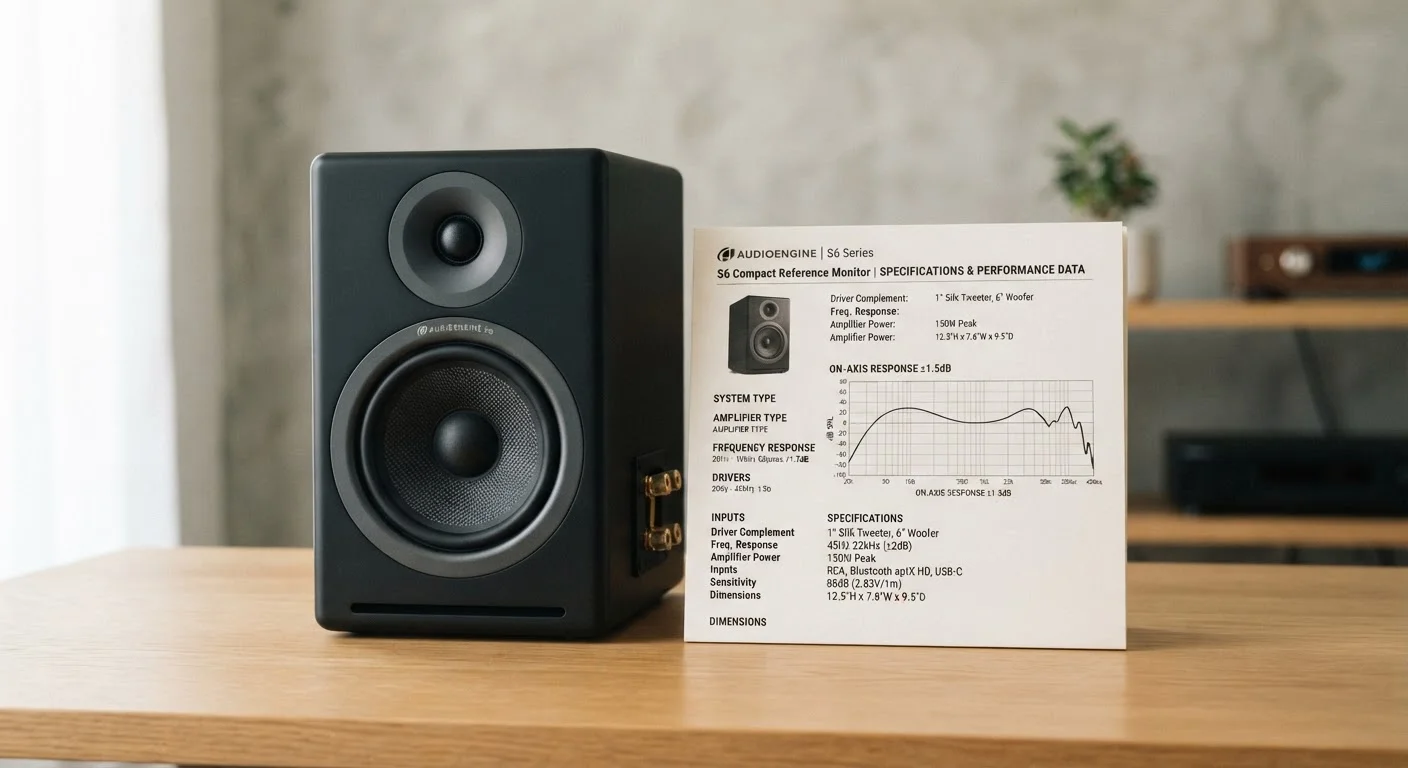
Photo: UltraSearches.com | Search Results You Can Trust editorial
Key Takeaways
- Wattage describes power handling, not loudness - more watts doesn't automatically mean better sound.
- Impedance (ohms) must be matched to your amplifier to avoid equipment damage or poor performance.
- Sensitivity ratings reveal how efficiently a speaker converts power into volume.
- Frequency response indicates the range of sound a speaker can reproduce, but the shape of the curve matters more than the endpoints.
- No single spec tells the whole story - specs work together and must be read in context.
Watts: Power Handling, Not Volume
The wattage figure on a speaker - often labeled RMS power handling - describes how much continuous power the speaker can accept from an amplifier without damage. It says almost nothing about how loud the speaker actually plays.
Peak wattage is a separate, often larger number that describes short-term power tolerance. Marketing materials frequently lead with peak figures, which can be misleading. Focus on RMS ratings when evaluating real-world capability.
A speaker rated at 50W RMS paired with a 30W amplifier will likely perform fine. The risk runs the other way: consistently underpowering a speaker and pushing a small amp into distortion can actually cause more driver damage than a clean, appropriately sized signal. Just as some spec numbers get heavy marketing attention but have little bearing on everyday experience, peak wattage is a prime example.
Ohms: The Matching Game
Impedance - measured in ohms (Ω) - is one of the most practically important specs to check before connecting any speaker to an amplifier or receiver. It describes the electrical load the speaker places on the driving equipment.
Common consumer speaker impedances are 4Ω, 6Ω, and 8Ω. Most home stereo receivers are optimized for 8Ω loads. Running a 4Ω speaker on a receiver rated only for 8Ω draws more current than the amplifier is designed to supply, which can cause overheating or trigger protection circuits.
Specs Vary by Measurement Method
Always cross-reference the speaker's minimum impedance with your amplifier's supported range - both figures appear in their respective manuals or spec sheets.
Sensitivity: The Efficiency Number That Predicts Loudness
Sensitivity is measured in decibels (dB) and tells you how loud a speaker plays when fed exactly 1 watt of power, measured from 1 meter away. A speaker rated at 90 dB sensitivity is meaningfully louder under identical conditions than one rated at 84 dB - because decibels are logarithmic, that 6 dB difference is roughly equivalent to doubling the amplifier power four times over.
For listeners using low-powered amplifiers - including many budget integrated amps or tube amplifiers - a high-sensitivity speaker (88 dB and above) is especially valuable. For powerful receivers driving a large room, sensitivity matters less because spare power is available.
6 dB
Sensitivity difference equals roughly 4x the amplifier power
Because decibels are logarithmic, a 6 dB increase in sensitivity is acoustically equivalent to quadrupling amplifier wattage - a well-established principle in audio engineering.
20 Hz-20 kHz
Approximate range of human hearing
This is the commonly cited boundary of healthy adult hearing; sensitivity at the upper extreme typically declines with age, per general audiological reference.
±3 dB
Standard tolerance window for quality speaker frequency response
Audio engineers widely consider ±3 dB a reasonable tolerance for accurate sound reproduction; wider windows indicate greater output variation across frequencies.
Frequency Response: Reading Between the Lines
Frequency response describes the range of audio frequencies a speaker can reproduce, typically shown as Hz-kHz (e.g., 50 Hz-20 kHz). A wider range sounds impressive, but the number alone doesn't tell you whether the speaker reproduces those frequencies accurately or at what volume variation.
The tolerance window - expressed as ±dB - is the figure that actually matters. A speaker rated 50 Hz-20 kHz ±3 dB maintains relatively consistent output across that range. One rated ±10 dB may have significant peaks and dips. Manufacturers don't always publish this tolerance, which is why frequency response graphs from independent reviewers are far more informative than endpoint numbers alone.
For reference, the full range of human hearing is approximately 20 Hz to 20,000 Hz - though most adults lose sensitivity at the upper extreme. Just as reading a food label requires understanding what the numbers actually represent, decoding what each figure measures is the same skill applied to a different domain.
Look for Third-Party Frequency Response Graphs
Putting the Numbers Together
No single spec paints a complete picture. A speaker with excellent sensitivity but poor impedance matching can stress your equipment. One with an impressive wattage rating but a narrow frequency response may disappoint for music that demands deep bass.
The most useful approach is to treat specs as a compatibility checklist first - verify impedance and sensitivity match your amplifier - then use frequency response and power handling as context for your use case. Independent measurement data and listening reviews fill in what specs alone cannot convey.
If you're also evaluating wireless audio, Bluetooth codec labels carry their own layer of specs worth decoding separately. The same principle applies: specs describe potential, not guaranteed experience.
Frequently Asked Questions
The content on this site is for informational purposes only and is not a substitute for professional advice. Always consult a qualified professional for guidance specific to your situation.