
Portable vs. Built-In Dishwashers: Weighing the Practical Differences

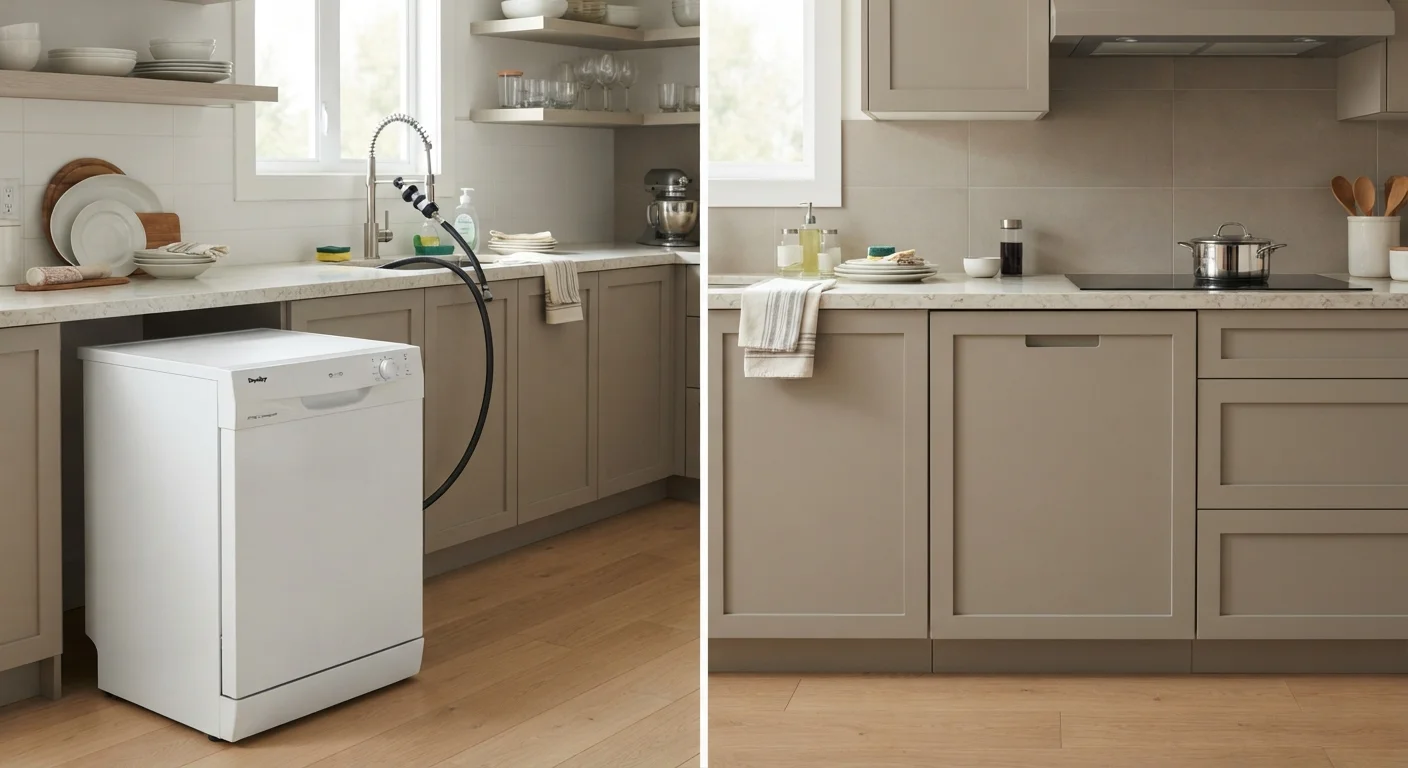
Photo: UltraSearches.com | Search Results You Can Trust editorial
Key Takeaways
- Portable dishwashers connect to a faucet temporarily and require no permanent installation, making them suitable for renters.
- Built-in dishwashers offer larger capacity and quieter operation, but require dedicated plumbing and cabinetry space.
- Water and energy consumption vary more by model and cycle selection than by dishwasher type alone.
- Portables cost less upfront but may have higher per-load costs due to smaller capacity and less efficient cycles.
- Your living situation, kitchen layout, and long-term plans should drive the decision more than price alone.
Installation and Setup: What Each Type Actually Requires
The most immediate difference between portable and built-in dishwashers is how they connect to your home's plumbing. A portable dishwasher uses a quick-connect adapter that hooks onto a standard kitchen faucet. You roll it into position, connect the hose, run a cycle, then disconnect and store it. No plumber required, no cabinetry modifications, no permanence.
A built-in dishwasher is permanently connected to your home's hot water supply line and drain, typically installed under the counter in a dedicated 24-inch opening. Installation usually involves a plumber and possibly a carpenter if the kitchen space needs adjustment. This is a meaningful upfront commitment - in both cost and effort - but it also means the appliance is out of the way and always ready to use.
For renters, the portable option is often the only realistic path. Landlords rarely approve permanent plumbing changes, and built-ins typically stay with the property. If you're a new homeowner evaluating your kitchen from scratch, see what new homeowners should know before stocking a kitchen for a broader look at appliance compatibility and space planning.
Capacity, Cleaning Performance, and Cycle Options
Built-in dishwashers typically hold 12 to 16 place settings per load. Standard portable models generally manage 8 to 12, and compact countertop portables may hold as few as 4 to 6. For households that cook frequently or have multiple family members, this gap adds up to more loads per week with a portable unit.
Cleaning performance is less about the form factor and more about the wash system design, water temperature, and spray arm coverage. Both types can clean effectively when loaded correctly. However, built-ins more commonly offer specialized cycles - heavy-duty, sanitize, half-load, and delay-start options - that provide flexibility for different dish types and schedules. Portable models, particularly entry-level ones, often have fewer cycle choices.
| Portable Dishwasher | Built-In Dishwasher | |
|---|---|---|
| Installation | Faucet connection, no permanent plumbing | Permanent plumbing, requires dedicated space |
| Typical Capacity | 4-12 place settings | 12-16 place settings |
| Noise Level | Louder, exposed during cycle | Quieter, enclosed in cabinetry |
| Upfront Cost | Generally lower | Generally higher, plus installation |
| Floor Space Required | Needed during use and storage | None - integrated under counter |
| Cycle Options | Fewer, often basic | More varied, specialized cycles common |
| Suitable for Renters | Yes | Rarely practical |
Noise is another practical consideration. Built-in dishwashers are enclosed within cabinetry, which muffles operating sound. Portable units sit exposed in the kitchen during a cycle, making them noticeably louder in open-plan living spaces.
Water Use, Energy Efficiency, and Running Costs
Modern dishwashers - both portable and built-in - use significantly less water than hand-washing, typically somewhere in the range of 3 to 5 gallons per cycle compared to 20 or more gallons for manual washing. That said, efficiency varies considerably by model, cycle length, and water temperature settings rather than strictly by type.
Because portable dishwashers generally have smaller tub capacities, running more loads to clean the same volume of dishes can partially offset the per-cycle efficiency. Built-in units with full capacity and efficient cycles tend to have a lower cost-per-setting washed over time. Running costs across appliances add up in ways that aren't always obvious - for a detailed breakdown, see the hidden costs of running home appliances year-round.
Check the Specification Sheet, Not Just the Label
Energy Star certification is available across both categories and is a useful baseline when evaluating models, though the label alone doesn't eliminate the need to compare actual estimated annual energy use figures listed in product specifications.
Space, Mobility, and Long-Term Practicality
Portable dishwashers occupy floor space when in use and need somewhere to be stored when not - often a tight fit in a smaller kitchen. Some households park them permanently in one spot and use them as an additional counter surface between cycles, which works reasonably well if the kitchen layout allows it.
Built-ins eliminate that footprint concern entirely. Once installed, they integrate into the kitchen and free up floor space. For homeowners planning to stay in a property long-term, a built-in also adds functional value to the home in a way a portable appliance does not.
Durability and repair access are broadly similar across both types, though built-ins have more standardized service access given their prevalence. If you're weighing similar trade-offs in other appliance categories, the same framework applies - the front-load vs. top-load washer comparison covers analogous installation and long-term cost questions for laundry machines.
Faucet Compatibility Isn't Always Automatic
The content on this site is for informational purposes only and is not a substitute for professional advice. Always consult a qualified professional for guidance specific to your situation.