
Bundling Auto and Home Insurance: What It Changes and What It Doesn't

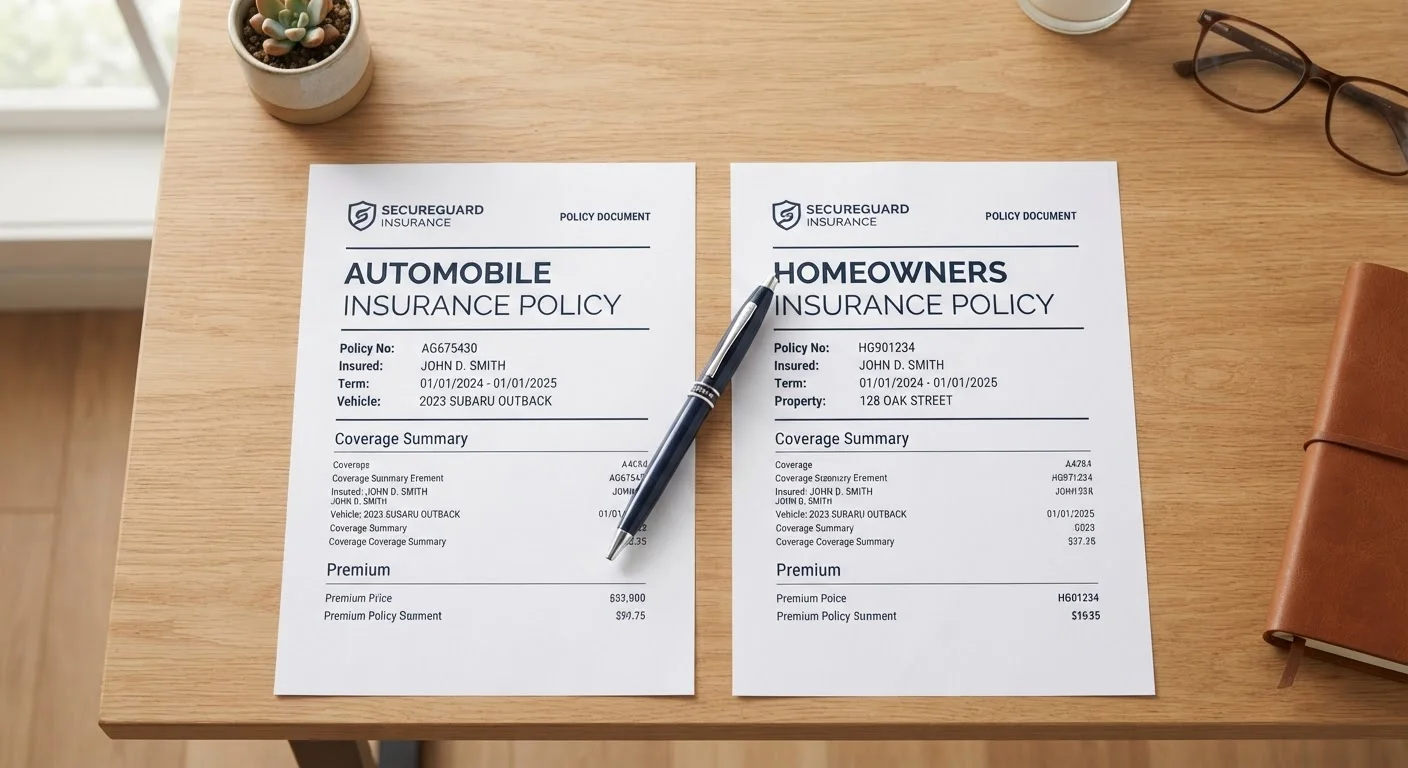
Photo: UltraSearches.com | Search Results You Can Trust editorial
Key Takeaways
- Bundling auto and home insurance under one insurer often yields a multi-policy discount, but savings vary widely.
- A single insurer managing both policies simplifies billing and claims, but doesn't merge coverage terms.
- Your auto and home policies remain legally separate contracts with independent deductibles and exclusions.
- The bundled price isn't always lower than buying each policy separately from different insurers.
- Review both policies individually to confirm coverage levels still meet your needs after bundling.
Multi-policy discount can reduce total premium cost
Most insurers offer a percentage reduction on one or both policies when you bundle. The size of the discount varies by insurer and state, but it can meaningfully offset overall insurance spending.
Single insurer simplifies billing and administration
One renewal calendar, one customer service line, and often one consolidated bill reduces the administrative load of managing separate insurer relationships.
Smoother claims coordination for overlapping events
When a single event - such as a storm - damages both your car and your home, having one insurer removes the friction of coordinating between two separate companies over liability.
Potential loyalty benefits over time
Some insurers offer additional perks for long-term customers who hold multiple policies, such as accident forgiveness or diminishing deductibles, though these features vary significantly by provider.
Bundled price isn't always the lowest available
The multi-policy discount is applied to that insurer's base rate - which may itself be higher than a competitor's rate for the same coverage. Always compare the bundled total against separate-market quotes.
Coverage quality can vary between policy lines
An insurer strong in auto may offer a less competitive homeowners product. Accepting a weaker policy to capture the discount can leave meaningful coverage gaps.
Policies remain separate contracts with separate deductibles
Bundling does not create a shared deductible. If you file claims on both policies for the same event, you pay each deductible independently, which can add up quickly.
Switching becomes more complex with bundled policies
If you want to change insurers - because rates rise or claims handling disappoints - you must replace both policies simultaneously or lose the bundle discount, adding friction to shopping around.
Discount can mask inadequate coverage levels
The appeal of saving money can distract from evaluating whether liability limits, replacement cost provisions, and exclusions are actually appropriate for your assets and risk exposure.
What Bundling Actually Means
When insurers talk about bundling, they mean purchasing two or more policies - most commonly auto and homeowners insurance - from the same insurance company. The insurer typically rewards this with a multi-policy discount, sometimes called a bundle discount, applied to one or both premiums.
It's important to understand what bundling does not mean: your auto and home coverages do not merge into a single policy. Each contract remains separate, with its own declarations page, deductible structure, exclusions, and renewal date. Understanding those individual terms is foundational - our plain-language glossary of key insurance terms can help if words like "exclusion" or "endorsement" feel unfamiliar.
The practical effect of bundling is mostly administrative: one insurer, often one billing statement, and a single point of contact for questions. The financial effect depends entirely on how the discounted bundle price compares to shopping each policy individually.
Renters Insurance Can Also Be Bundled
The Real Advantages of Bundling
There are genuine, concrete benefits to consolidating policies - provided the underlying coverage is sound.
Multi-policy discount can reduce total premium cost
Most insurers offer a percentage reduction on one or both policies when you bundle. The size of the discount varies by insurer and state, but it can meaningfully offset overall insurance spending.
Single insurer simplifies billing and administration
One renewal calendar, one customer service line, and often one consolidated bill reduces the administrative load of managing separate insurer relationships.
Smoother claims coordination for overlapping events
When a single event - such as a storm - damages both your car and your home, having one insurer removes the friction of coordinating between two separate companies over liability.
Potential loyalty benefits over time
Some insurers offer additional perks for long-term customers who hold multiple policies, such as accident forgiveness or diminishing deductibles, though these features vary significantly by provider.
One underappreciated benefit is smoother claims handling when both your car and home are damaged in the same event - a severe hailstorm, for example. With a single insurer, there is no dispute between two companies about which policy responds to which damage. That said, your auto and home deductibles still apply separately; bundling doesn't create a single shared deductible.
The Limitations Worth Knowing
Bundling is marketed heavily, which means its downsides tend to get less airtime. Here are the constraints every policyholder should factor in.
Bundled price isn't always the lowest available
The multi-policy discount is applied to that insurer's base rate - which may itself be higher than a competitor's rate for the same coverage. Always compare the bundled total against separate-market quotes.
Coverage quality can vary between policy lines
An insurer strong in auto may offer a less competitive homeowners product. Accepting a weaker policy to capture the discount can leave meaningful coverage gaps.
Policies remain separate contracts with separate deductibles
Bundling does not create a shared deductible. If you file claims on both policies for the same event, you pay each deductible independently, which can add up quickly.
Switching becomes more complex with bundled policies
If you want to change insurers - because rates rise or claims handling disappoints - you must replace both policies simultaneously or lose the bundle discount, adding friction to shopping around.
Discount can mask inadequate coverage levels
The appeal of saving money can distract from evaluating whether liability limits, replacement cost provisions, and exclusions are actually appropriate for your assets and risk exposure.
Coverage gaps are the most consequential concern. If an insurer's auto product is strong but its homeowners product has narrower coverage for, say, water backup or personal property replacement, bundling for the discount could mean accepting inferior protection. Always read what each policy covers - see what your auto policy actually covers for a breakdown of auto coverage types.
It also pays to reassess a bundle whenever your life circumstances shift. A new home purchase, adding a teen driver, or a significant renovation can all change what coverage you actually need. Our structured checklist for reviewing coverage after a major life change walks through those triggers in detail.
How to Evaluate Whether Bundling Makes Sense for You
The right way to assess a bundle is to treat it like any other purchasing decision: compare total cost and total value, not just the discount percentage.
- Get separate quotes first. Before accepting a bundle, obtain standalone quotes for both auto and home from multiple insurers. The bundled price may still be higher than the sum of two separately purchased policies.
- Compare coverage terms, not just premiums. A lower bundled premium is only a benefit if the coverage is equivalent. Pay particular attention to liability limits - understanding liability versus full coverage is a useful starting point.
- Check each insurer's claims reputation. State insurance department websites publish complaint ratios by insurer, which can signal how smoothly claims are handled.
- Revisit annually at renewal. Discounts and competitor pricing both change year over year. A bundle that was competitive last year may not be this year.
5-25%
Typical multi-policy discount range
The Insurance Information Institute notes that multi-policy discounts generally fall in this range, though the actual amount depends on the insurer and state.
~70%
Homeowners who also bundle auto
Industry estimates suggest a substantial majority of homeowners who carry auto insurance bundle at least one of their policies with the same carrier, making it one of the most common discount strategies used.
This article provides general insurance education and is not personalized insurance or financial advice. Coverage terms, eligibility, and pricing vary by insurer, policy, and state. Read your policy documents carefully and consult a licensed insurance agent or adviser for guidance specific to your situation.
The content on this site is for informational purposes only and is not a substitute for professional advice. Always consult a qualified professional for guidance specific to your situation.