
Named Perils vs. Open Perils Home Insurance Coverage

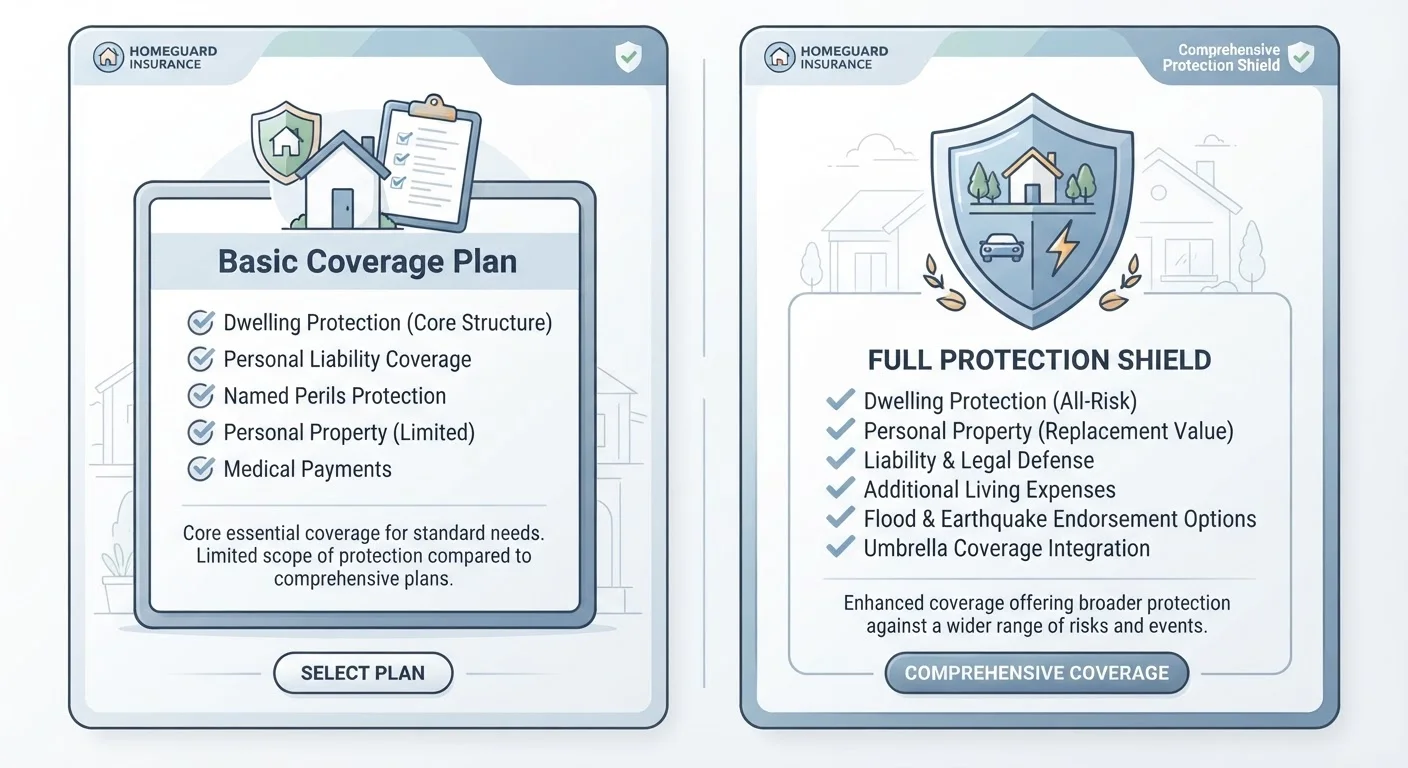
Photo: UltraSearches.com | Search Results You Can Trust editorial
Key Takeaways
- Named perils policies only pay claims for causes of loss explicitly listed in the policy document.
- Open perils policies cover all causes of loss except those the policy specifically excludes.
- The HO-3, the most common homeowners policy, uses open perils for the dwelling and named perils for personal property.
- With named perils, the policyholder must prove the cause of loss is on the list; with open perils, the insurer must prove an exclusion applies.
- Neither policy type covers every possible loss - exclusions such as floods and earthquakes apply to both.
- Reviewing your declarations page and policy form reveals which coverage type applies to each part of your home.
The Core Distinction: What Triggers a Covered Claim
When a pipe bursts, a tree falls on your roof, or a fire damages your kitchen, the first question your insurer asks is: what caused this loss? The answer only matters for your coverage if your policy form says it does - and that's where named perils and open perils diverge completely.
A named perils policy lists specific causes of loss - called perils - that trigger coverage. Common named perils include fire, lightning, windstorm, hail, theft, vandalism, and a handful of others. If the cause of your loss appears on that list, you have a covered claim. If it does not, the claim is denied, regardless of how severe the damage is.
An open perils policy (sometimes called "all-risk" coverage, though insurers have largely moved away from that term) works in reverse. It covers any cause of loss that the policy does not explicitly exclude. The exclusions list - not a coverage list - defines the boundaries. This shifts the burden of proof: under named perils, you must demonstrate the cause matches a listed peril; under open perils, the insurer must point to a specific exclusion to deny your claim.
For a deeper look at how policy language shapes your rights, see our plain-language insurance glossary.
| Criterion | Named Perils | Open Perils |
|---|---|---|
| Coverage trigger | Cause must match a listed peril | All causes covered unless excluded |
| Burden of proof | Policyholder proves cause is listed | Insurer proves exclusion applies |
| Typical premium | Generally lower | Generally higher |
| Breadth of protection | Narrower, defined scope | Broader, catch-all scope |
| Common policy forms | HO-1, HO-2, HO-3 (contents) | HO-3 (dwelling), HO-5 |
| Ambiguous cause of loss | Likely denied if unlisted | Likely covered if not excluded |
| Exclusions apply? | Yes - and coverage list limits further | Yes - exclusions define the boundaries |
How Standard Homeowners Policies Actually Use Both
Most American homeowners carry an HO-3 policy, which is a hybrid: it applies open perils coverage to the dwelling (your home's structure) and named perils coverage to personal property (your belongings inside). This means a mysterious structural loss is more likely to be covered than a mysterious loss of personal items - a nuance many policyholders don't realize until they file a claim.
An HO-5 policy extends open perils to both the dwelling and personal property, providing broader protection across the board. An HO-1 or HO-2 policy applies named perils to everything and lists fewer covered perils than a standard HO-3.
Universal Exclusions Still Apply
Regardless of which form applies, certain exclusions appear in nearly every homeowners policy. Flood damage, earthquake damage, sewer backup, and losses from normal wear and tear are almost universally excluded. These require separate policies or endorsements. See coverage gaps homeowners discover too late for a detailed breakdown of what standard policies routinely leave out.
To understand the full structure of an HO-3 - including Coverages A through F - the parts of a homeowners policy most people never read offers a section-by-section explanation.
~96%
U.S. homeowners with an HO-3 policy
The HO-3 is the dominant homeowners policy form in the United States, according to the Insurance Information Institute, making its hybrid named/open perils structure the most common arrangement American homeowners encounter.
Burden shift
Key claims advantage of open perils
Under open perils, the insurer must identify a specific policy exclusion to deny a claim - a structural difference from named perils that can meaningfully affect claim outcomes for ambiguous losses.
Practical Implications When You File a Claim
The coverage form type has real consequences at claims time. Under a named perils policy, if your adjuster cannot identify the cause of loss - or the identified cause isn't on the list - the claim can be denied even if the damage is obvious. Water damage from a burst pipe is usually listed; water damage from gradual seepage usually is not.
Under open perils, ambiguous causes of loss are more likely to result in payment, because the insurer bears the burden of identifying a specific exclusion. This doesn't mean open perils coverage pays every claim - exclusions are real and enforceable - but it does mean the policyholder starts from a stronger position.
The practical advice: read your declarations page to identify which form type applies to your dwelling and your personal property separately. If you have questions about whether a specific type of loss would be covered, ask your agent before the loss occurs - not after. This is general information about how policy structures work; your actual coverage depends on your specific policy language, your insurer, and your state's regulations. A licensed insurance professional can review your individual policy and help you assess whether your current coverage form fits your situation.
For comparisons beyond homeowners coverage, liability vs. full coverage auto insurance explains a similarly important distinction in the auto context.
The content on this site is for informational purposes only and is not a substitute for professional advice. Always consult a qualified professional for guidance specific to your situation.