
Deductible vs. Out-of-Pocket Maximum: Two Numbers That Shape Your Health Costs

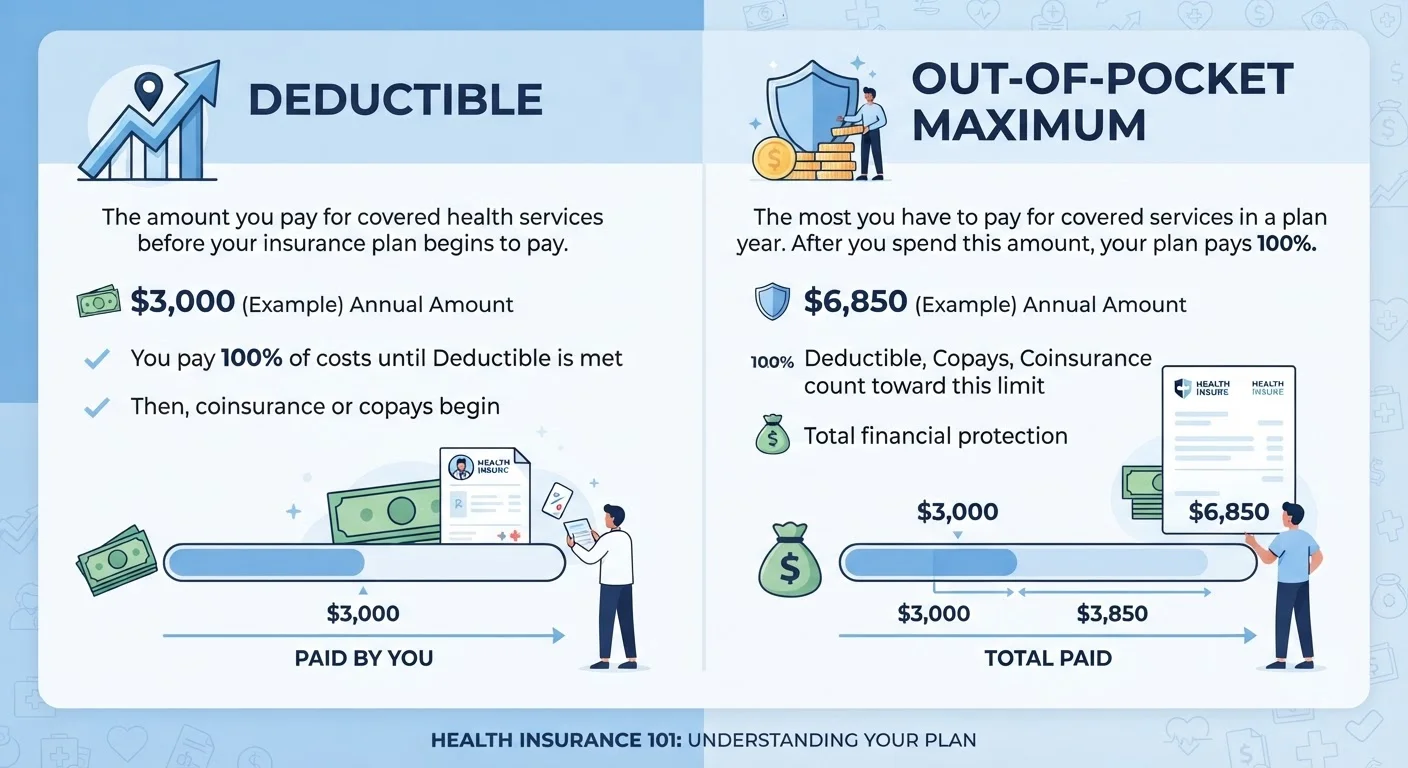
Photo: UltraSearches.com | Search Results You Can Trust editorial
Key Takeaways
- Your deductible is the amount you pay entirely on your own before insurance begins covering a share of costs.
- Your out-of-pocket maximum is the most you'll pay in a plan year - after that, insurance covers 100%.
- Both figures reset at the start of each new plan year, usually January 1.
- Copays and coinsurance count toward your out-of-pocket maximum but may or may not count toward your deductible.
- Premiums never count toward either figure, regardless of how much you pay over the year.
What Is a Deductible?
A deductible is the fixed dollar amount you pay for covered health care services before your insurance plan starts sharing the cost. For example, if your deductible is $1,500, you pay the full bill for most covered services until your cumulative spending reaches that threshold - then the plan begins contributing.
It's important to note that not every service counts against your deductible. Many plans cover preventive care (such as annual wellness visits and certain screenings) at no cost to you, even before you've met your deductible. Copays for primary care or specialist visits may also be charged separately, depending on how your plan is structured.
Deductibles reset at the start of each plan year. If your plan year runs January through December, any progress you made toward your deductible in one year does not carry over. This is a common surprise for people who receive care late in the calendar year and then face a fresh deductible in January. For a broader look at the terms surrounding deductibles, see our plain-English guide to health insurance terms.
What Is an Out-of-Pocket Maximum?
The out-of-pocket maximum (sometimes called the out-of-pocket limit) is the most you will ever pay for covered in-network services in a single plan year. Once you reach this ceiling - through a combination of your deductible, copayments, and coinsurance - your insurance plan pays 100% of covered costs for the remainder of the year.
Think of it as your worst-case financial exposure. If you face a serious illness, surgery, or extended hospital stay, the out-of-pocket maximum is the number that tells you: this is as bad as it gets for covered, in-network care.
ACA Caps and What Counts
Under the Affordable Care Act (ACA), plans sold through the Health Insurance Marketplace are required to cap out-of-pocket costs at federally set limits, which are adjusted annually. For plan year 2024, those limits were $9,450 for an individual and $18,900 for a family. Employer-sponsored and grandfathered plans may have different structures; always check your Summary of Benefits and Coverage document for your specific figures.
Also worth noting: your monthly premium - the amount you pay to maintain coverage - does not count toward your out-of-pocket maximum, no matter how high it is. This surprises many people who assume all their health-related spending accumulates in one place.
How the Two Numbers Interact
These two figures work in sequence, not in isolation. Here's a simplified path through a plan year:
- You receive a covered service and pay the full cost until you've met your deductible.
- After the deductible is met, you begin sharing costs with your insurer - typically through coinsurance (a percentage split, such as 80/20) or copays (fixed amounts per visit).
- As your spending accumulates, it works toward your out-of-pocket maximum.
- Once the maximum is reached, your insurer covers 100% of covered in-network costs for the rest of the plan year.
This means your deductible is always lower than - or equal to - your out-of-pocket maximum, never higher. They are not two separate buckets; your deductible spending counts toward your out-of-pocket maximum.
| Criterion | Deductible | Out-of-Pocket Maximum |
|---|---|---|
| What it represents | Amount you pay before insurance shares costs | Total annual cap on your covered cost-sharing |
| When it matters most | Early in the plan year or after a new service | During a high-cost year with serious illness or injury |
| Does it include premiums? | No | No |
| Counts toward the other? | Yes - deductible spending counts toward the max | N/A - it is the ceiling |
| What happens after you reach it? | Cost-sharing (copays, coinsurance) begins | Insurer pays 100% of covered in-network costs |
| Reset frequency | Annually, at plan year start | Annually, at plan year start |
| Typical range (individual, 2024) | $500-$7,000+ depending on plan type | Up to $9,450 for ACA marketplace plans |
One important nuance: out-of-network costs may not count toward your in-network out-of-pocket maximum, depending on your plan type. This can create significant unexpected costs. Our article on in-network vs. out-of-network costs explains exactly why the distinction matters.
Using Both Numbers to Plan Your Health Budget
Understanding these two figures lets you approach health care spending strategically rather than reactively. When reviewing a plan, consider these practical questions:
- How much care do I realistically expect this year? If you anticipate significant medical needs, a lower deductible may reduce early-year spending even if the premium is higher.
- What is my financial buffer for a bad year? The out-of-pocket maximum tells you the absolute most you'd need to cover. If that figure would strain your finances, factor it into plan selection.
- Do my prescriptions count? Some plans use a separate deductible for prescription drugs. Read your plan documents carefully to understand what counts where.
People who choose high-deductible health plans (HDHPs) take on more early-year financial exposure in exchange for lower premiums. Our look at HDHP tradeoffs walks through who this structure tends to suit and who should think carefully before choosing one.
For help seeing how these costs connect to your overall health insurance bill, including premiums and subsidies, see our complete guide to health insurance costs. And if you're working deductibles into a household budget, the Budgeting Basics hub offers straightforward frameworks for tracking and planning expenses.
This article is for general informational and educational purposes only. It does not constitute personalized financial, legal, or insurance advice. Coverage terms, figures, and regulations vary by plan and state. Always review your actual plan documents and consult a licensed insurance professional for guidance specific to your situation.
The content on this site is for informational purposes only and is not a substitute for professional advice. Always consult a qualified professional for guidance specific to your situation.