
How the American Health Insurance System Is Structured

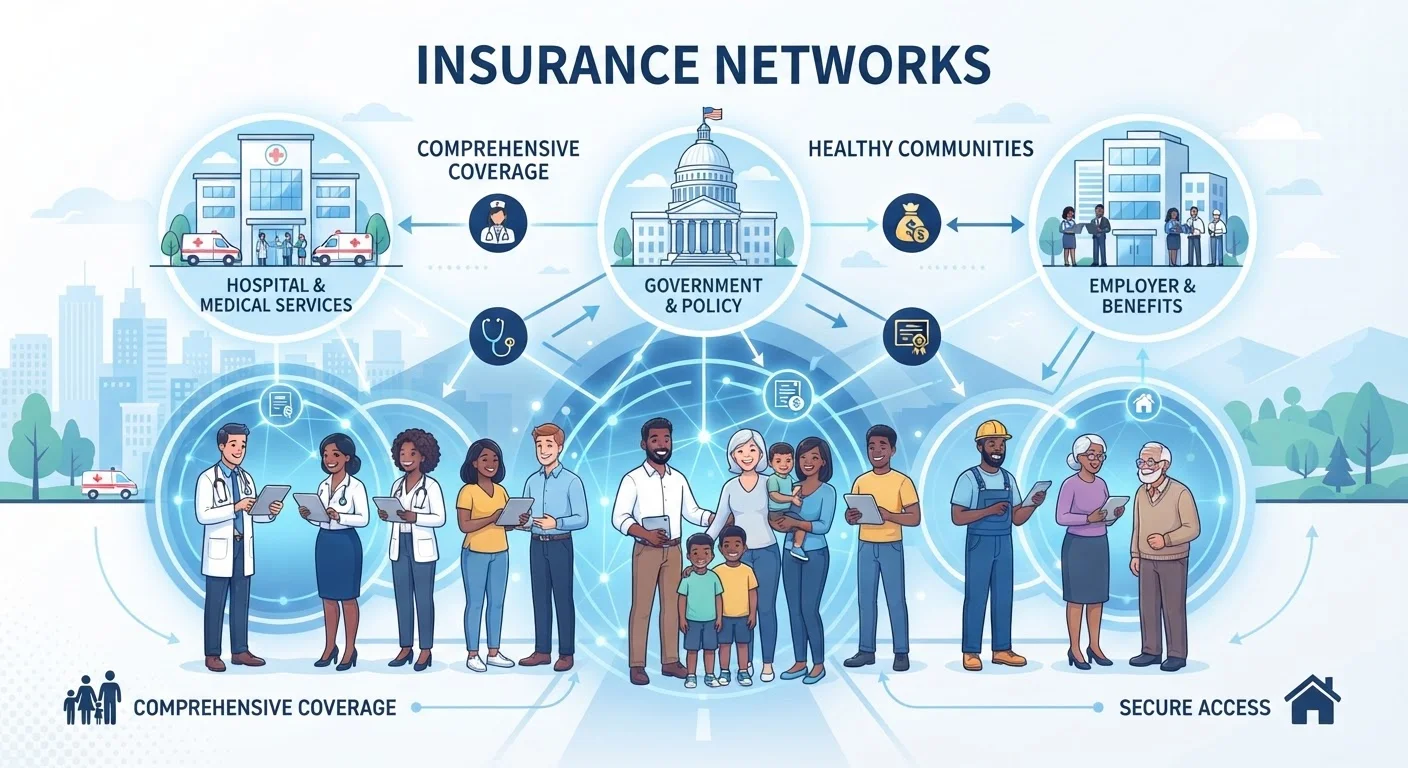
Photo: UltraSearches.com | Search Results You Can Trust editorial
Key Takeaways
- The U.S. health insurance system is a mix of private and government-run programs, not a single unified system.
- Most Americans under 65 get coverage through an employer, while others purchase plans independently or qualify for government programs.
- Risk pooling is the core financial principle: healthy and sick members share costs so coverage stays broadly affordable.
- The ACA created marketplaces where individuals can shop for coverage and access income-based subsidies.
- Medicare covers Americans 65 and older; Medicaid covers low-income individuals and families based on eligibility rules that vary by state.
- Understanding which coverage channel you qualify for is the first step toward choosing the right plan.
The Core Principle: Risk Pooling
Every form of health insurance - whether offered by an employer, sold on a marketplace, or administered by the government - rests on a single financial idea called risk pooling. When a large group of people pays premiums into a shared fund, that fund is used to cover the medical costs of whichever members need care in a given period. Because serious illness affects only a portion of the group at any time, the cost is spread across everyone rather than falling entirely on the individual who gets sick.
The larger and more diverse the pool, the more predictable and stable the costs tend to be. This is why employer-sponsored plans often have broader benefits than small individual plans - a large workforce creates a naturally diverse risk pool. Understanding this principle helps explain many of the system's design choices, from why insurers care about how many people are enrolled to why the ACA included an individual coverage requirement.
~54%
Americans covered by employer-sponsored insurance
According to KFF (Kaiser Family Foundation) analysis of federal data, roughly half of the U.S. population receives health coverage through an employer.
~18%
Americans enrolled in Medicaid and CHIP
Federal and state data show Medicaid and CHIP together cover tens of millions of low-income adults, children, and individuals with disabilities.
~14%
Americans covered by Medicare
Medicare serves more than 65 million beneficiaries, primarily adults 65 and older, according to CMS enrollment data.
Employer-Sponsored Insurance: The Largest Coverage Channel
The majority of Americans under 65 receive health coverage through a job - either their own or a family member's. Employer-sponsored insurance (ESI) developed in the mid-20th century partly because employer premium contributions were treated as tax-advantaged compensation. Today, employers typically pay a significant share of monthly premiums, with employees covering the remainder through payroll deductions.
Employers generally contract with one or more private insurers to offer plan options, and federal law under ERISA governs many aspects of how those plans are structured and administered. Employees can usually choose among plan types during an annual open enrollment period. For a detailed look at what plan types mean in practice, see our guide on HMO, PPO, EPO, and HDHP differences.
Check Whether Employer Coverage Is 'Affordable'
Government Programs: Medicare, Medicaid, and CHIP
For populations that employer coverage typically doesn't reach, the federal and state governments operate three major programs.
- Medicare is a federal program that primarily covers Americans 65 and older, as well as certain younger individuals with qualifying disabilities or conditions. It is divided into parts that cover hospital care, outpatient services, and prescription drugs.
- Medicaid is a joint federal-state program providing coverage to low-income individuals and families. Eligibility criteria and benefits vary significantly from state to state. Under the ACA, most states expanded Medicaid to cover adults up to 138% of the federal poverty level, though some states have not adopted the expansion.
- CHIP fills a gap by providing coverage to children in families whose income exceeds Medicaid limits but who cannot easily afford private insurance.
These programs are funded through a combination of federal taxes, state appropriations, and, in the case of Medicare, payroll taxes and beneficiary premiums.
Medicaid Expansion Varies by State
The ACA Marketplace and Individual Coverage
The Affordable Care Act, enacted in 2010, created a new channel: regulated online marketplaces (sometimes called exchanges) where individuals and families can compare standardized private health plans and, depending on income, receive federal financial assistance. Plans sold on the marketplace must cover a set of essential health benefits and cannot deny coverage based on pre-existing conditions.
Financial assistance comes in two main forms: premium tax credits, which reduce monthly premiums, and cost-sharing reductions, which lower out-of-pocket costs for lower-income enrollees. To understand how these subsidies interact with premiums and other costs, see our explainer on how premiums, subsidies, and costs connect.
If you're navigating health insurance for the first time, our guide to starting your first health insurance plan walks through enrollment steps and key concepts. And for plain-English definitions of terms like deductibles, copays, and coinsurance, see Health Insurance Decoded.
“The American health care system is neither purely public nor purely private - it is a patchwork of programs, each serving a different population, held together by the shared principle that spreading risk makes care more financially accessible.”
— Insurance Basics Editorial Team, Health Insurance Editors
How the Pieces Fit Together
The U.S. health insurance landscape can feel fragmented precisely because it evolved through multiple overlapping systems rather than being designed as a whole. A 55-year-old teacher covered by a public-employee plan, a 28-year-old freelancer buying on the marketplace, a retired 67-year-old on Medicare, and a low-income parent on Medicaid are all part of the same national system - but their experiences, costs, and coverage options are quite different.
What they share is the same underlying logic: pooled premiums fund shared risk, regulated by a combination of federal and state oversight. Health insurance is also distinct from other types of insurance - to compare it with coverages like umbrella, travel, or specialty policies, see Specialty Insurance Types Every American Consumer Should Know About.
This article is for general informational and educational purposes only and does not constitute personalized insurance, financial, or legal advice. Coverage terms, costs, and eligibility rules vary by plan, insurer, and state. Consult a licensed insurance agent or adviser for guidance specific to your situation.
Frequently Asked Questions
The content on this site is for informational purposes only and is not a substitute for professional advice. Always consult a qualified professional for guidance specific to your situation.