
The Lifecycle of a Credit Score: How It Typically Evolves Over Decades

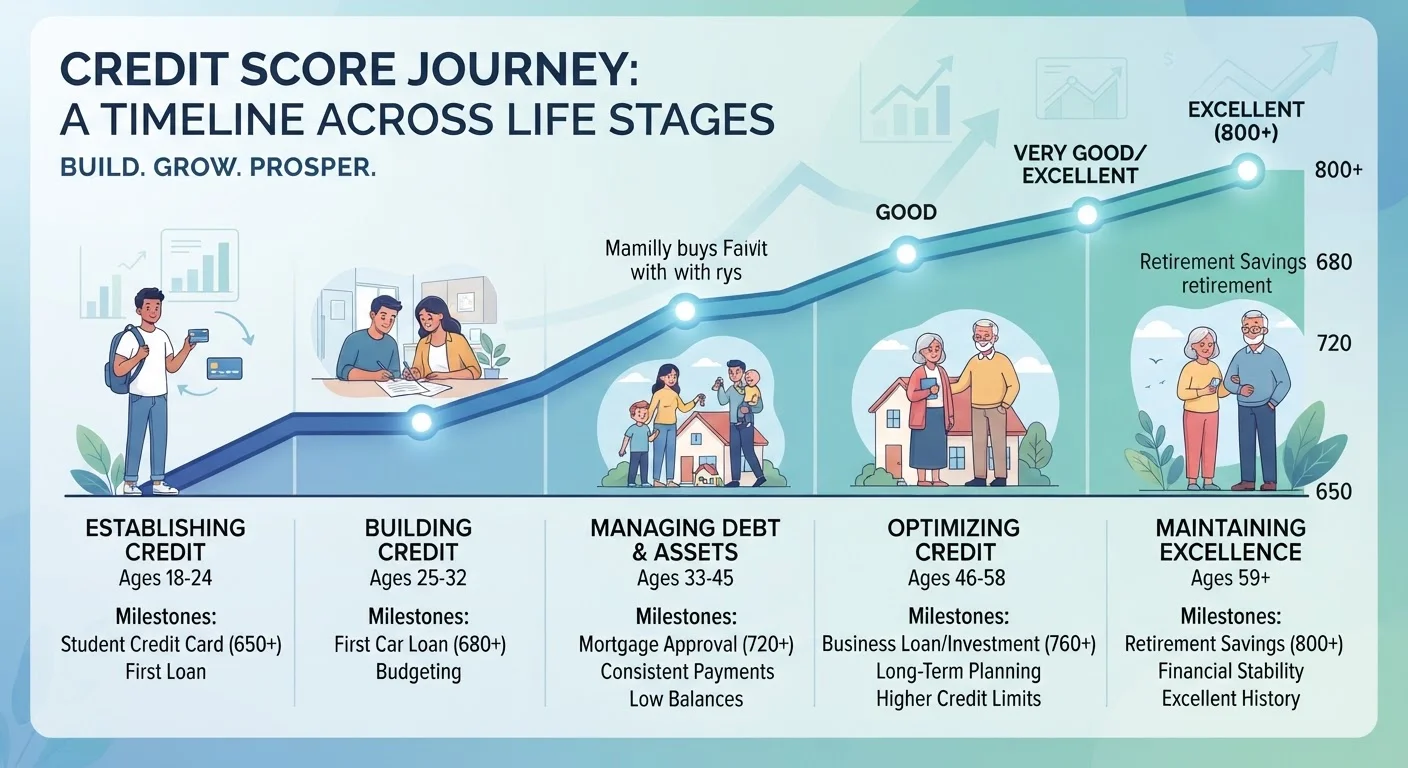
Photo: UltraSearches.com | Search Results You Can Trust editorial
Key Takeaways
- Credit scores typically start low and rise gradually with responsible account management.
- Average scores tend to increase with age, largely because of longer credit history and lower utilization.
- Major life events - divorce, job loss, medical debt - can disrupt scores at any stage.
- The fundamentals that build credit in your 20s remain relevant throughout your entire financial life.
- Monitoring your credit report regularly helps catch errors before they do lasting damage.
Why Credit Scores Change Over Time
A credit score is not a fixed trait - it's a living calculation that responds to your financial behavior, the age of your accounts, and how lenders report your activity. FICO scores, the most widely used model, weigh five factors: payment history (35%), amounts owed (30%), length of credit history (15%), new credit (10%), and credit mix (10%). Because length of history and payment history together account for half the score, time itself plays a significant role.
According to Experian data, average FICO scores increase steadily across age groups - consumers in their 20s average in the low-to-mid 600s, while those in their 60s and 70s average in the mid-700s. That gap isn't automatic; it reflects the compounding effect of decades of on-time payments and aging accounts. Understanding this arc helps you set realistic expectations and make smarter decisions at every stage.
716
Average FICO score for U.S. consumers
According to Experian's State of Credit report, the national average FICO score has trended upward over the past decade.
~100 pts
Typical score gap between 20s and 60s
Experian data consistently shows consumers in their 60s averaging roughly 100 points higher than those in their 20s.
35%
Weight of payment history in FICO score
Payment history is the single largest factor in the FICO scoring model, making on-time payments the highest-leverage habit.
Starting Out: Building Credit in Your 20s
For most people, the credit journey begins with a thin file - little or no history - which itself can translate to a lower score or no scoreable profile at all. Building credit from scratch typically means opening a first account, such as a secured card or a credit-builder loan, and demonstrating consistent repayment.
Early scores are often volatile. A single missed payment or a high balance relative to your credit limit can move the needle sharply downward when your file is thin. This is also the decade when many people take on student loans, which adds an installment account to the mix - helpful for credit diversity, but a risk if payments are missed.
If you're just starting out, treat your first credit card like a debit card - only charge what you can pay in full each month, and never carry a balance.
Become an authorized user on a trusted family member's older account to gain account age on your credit file without taking on debt yourself.
By the late 20s, someone who has managed one or two accounts responsibly for several years typically sees scores in the mid-to-upper 600s. That range is enough to qualify for many standard products, though interest rates may still be higher than those offered to more established borrowers.
The Growth Years: Credit in Your 30s and 40s
This period brings the most significant life-event pressure on credit scores. Buying a home, financing a vehicle, getting married or divorced, starting a business, or navigating a job loss can all leave marks - positive or negative. A mortgage, when paid on time, adds a powerful long-term installment account that bolsters payment history and credit mix simultaneously.
Divorce is one of the most underestimated credit disruptions. Joint accounts can become liabilities if an ex-spouse stops paying, and the legal process of separating finances takes time. Anyone going through a major financial transition should review their credit report carefully to catch errors or unauthorized accounts.
Divorce Can Disrupt Credit Unexpectedly
By the mid-40s, consumers who have avoided serious delinquencies generally see scores climbing into the 700s. The credit history is now long enough to provide meaningful cushion - a single late payment hurts less than it did at 25, because it's averaged across years of positive history.
Peak and Plateau: Credit in Your 50s and 60s
Scores often reach their highest point during these decades. Accounts opened in the 20s are now 30+ years old, contributing significantly to average account age. Mortgages may be paid off or nearly so, and overall debt loads frequently decline. These conditions - long history, lower utilization, established payment patterns - are exactly what scoring models reward.
One subtle risk: as people pay off and close accounts, they can inadvertently shorten their average account age or raise their credit utilization ratio by reducing available credit. Keeping older accounts open, even with minimal activity, generally supports the score more than closing them.
Keep Old Accounts Active in Retirement
Retirees often use credit less frequently, which is fine - but going too long without any activity on a card can cause issuers to close the account for inactivity, which has the same unintended effect. A small recurring charge paid in full each month keeps accounts active without creating debt.
Common Score Disruptions at Any Age
Scores don't move in a straight line. Across every decade, certain events reliably cause temporary or lasting declines:
- Late or missed payments: The single largest scoring factor. Even one 30-day late mark can drop a score significantly.
- High credit utilization: Carrying balances above 30% of available credit - even temporarily - signals risk to lenders.
- Hard inquiries from new credit applications: Each inquiry causes a small, temporary dip. Multiple inquiries in a short period amplify the effect.
- Medical debt: Major scoring models have reduced or eliminated the impact of paid medical debt, but unpaid collections still carry weight.
- Identity theft or reporting errors: Inaccuracies on your report can drag scores down through no fault of your own.
Understanding the habits that silently erode a good credit score helps you avoid preventable setbacks at any life stage.
Errors on Your Report Can Cost You Real Money
Habits That Support a Strong Score Across Decades
The behaviors that protect and build credit don't really change across life stages - what changes is the stakes. A few durable habits matter regardless of age:
- Pay on time, every time. Set up autopay for at least the minimum if cash flow is a concern.
- Keep utilization low. Aim to use less than 30% of your available revolving credit at any given time.
- Don't close old accounts unnecessarily. The age of your oldest account contributes to your score.
- Check your credit report annually. You're entitled to free reports from each major bureau; use them to spot errors early.
- Apply for new credit selectively. Only open accounts you genuinely need.
Credit scores are ultimately a reflection of financial habits compounded over time. The earlier you build good ones, the more resilience you carry into every decade that follows.
This article is for general informational and educational purposes only and does not constitute personalized financial or credit advice. Consult a qualified financial professional for guidance specific to your situation.
The content on this site is for informational purposes only and is not a substitute for professional advice. Always consult a qualified professional for guidance specific to your situation.