
What Road Signs Are Actually Telling You - and What Drivers Often Miss

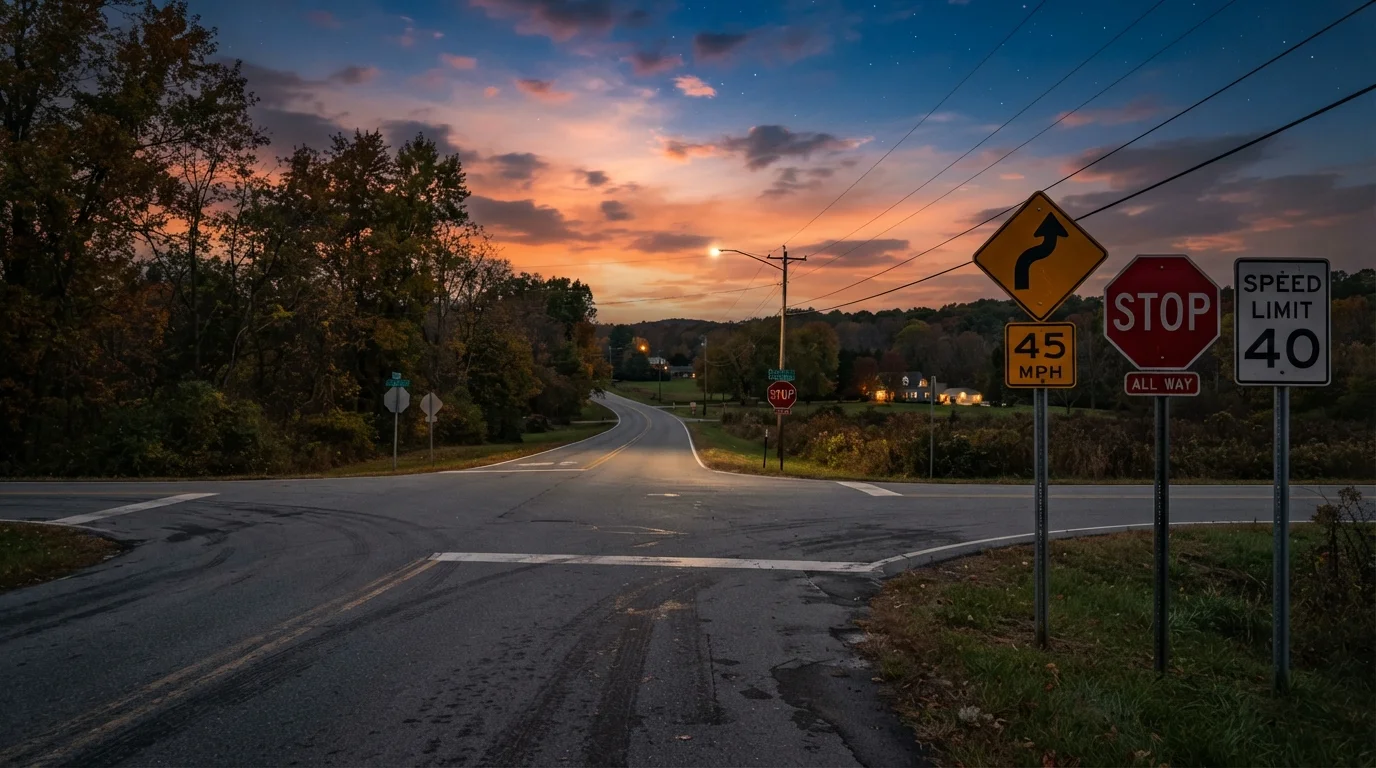
Photo: UltraSearches.com | Search Results You Can Trust editorial
The Three Categories Every Driver Should Know
U.S. road signs fall into three federally standardized categories defined by the MUTCD: regulatory, warning, and informational/guide signs. Shape and color are the fastest way to decode a sign before you can read its text - a critical advantage at highway speeds.
| Regulatory sign color | White or red background (FHWA MUTCD) |
| Warning sign shape | Yellow diamond (FHWA MUTCD) |
| Guide sign color | Green (routes/distances) or Blue (services) (FHWA MUTCD) |
| Standard sign authority | Federal Highway Administration (FHWA) |
| Advisory speed signs | Yellow placard; not a legal speed limit (FHWA MUTCD) |
| Closed lane indicator | Red X overhead sign (FHWA MUTCD) |
Regulatory signs (typically white or red backgrounds) communicate legal requirements. Running a red light, ignoring a Do Not Enter sign, or missing a No U-Turn marker are all violations, not suggestions. Warning signs use a yellow diamond and alert drivers to road conditions or hazards ahead - sharp curves, merging traffic, pedestrian crossings. These are advisory but directly tied to crash risk. Guide signs use green or blue backgrounds to provide route, distance, and service information.
Understanding this hierarchy matters because many drivers mentally file warning signs as optional information. In reality, a Slippery When Wet sign is telling you that engineers measured the curve's friction coefficient and found it dangerous in rain - that's not a suggestion to consider slowing down.
Signs Drivers Most Commonly Misread or Dismiss
Several signs generate consistent confusion or complacency among even experienced drivers:
- Yield vs. Stop: A yield sign means slow down and give right-of-way if traffic is present - it does not always require a full stop. However, if cross traffic is approaching, stopping is legally required. Many drivers either roll through without checking or stop unnecessarily when the road is clear. See how right-of-way rules actually work for a full breakdown.
- Advisory speed signs: The yellow placard on a curve that reads "35 MPH" is not a speed limit - it's the speed at which engineers determined the curve can be safely navigated under normal conditions. The legal speed limit may be higher. Wet or icy pavement changes the calculus entirely. Posted speed limits don't always equal safe speed - conditions matter.
- Lane control signs: A red X over a lane means that lane is closed to traffic - not just preferred for avoidance. White downward arrows indicate open lanes. These signs are especially misread in reversible-lane corridors and tunnel approaches.
- Divided highway ends: This warning sign tells drivers that the center median disappears ahead and they will encounter two-way traffic. Missing it on rural roads has contributed to serious head-on collisions.
MUTCD
The Manual on Uniform Traffic Control Devices, published by the Federal Highway Administration. It sets the national standard for the design, placement, and meaning of all road signs, signals, and pavement markings in the U.S.
Regulatory sign
A sign that communicates a legal requirement or prohibition - such as speed limits, stop requirements, or turn restrictions. Violating these signs is a traffic offense.
Warning sign
A yellow diamond-shaped sign alerting drivers to a potential hazard or change in road conditions ahead, such as a sharp curve, intersection, or pedestrian crossing.
Advisory speed
The speed recommended on warning signs (typically on curves), reflecting the speed engineers determined is safe under normal conditions. It is not a legal speed limit.
Lane control sign
An overhead sign using symbols - such as a red X or green arrow - to indicate which lanes are open or closed to traffic at a given time.
Guide sign
A green or blue sign providing directional, distance, or service information to help drivers navigate routes and find destinations.
Work zone and school zone signage adds another layer of legal obligation. Fines and rules in these zones are frequently more stringent than standard traffic law - and they vary by state.
What Signs Can't Tell You - and What Fills the Gap
Road signs communicate fixed, pre-engineered information. They cannot account for real-time conditions: ice that formed after the last inspection, debris from an overnight storm, or a vehicle stopped around a blind curve. That gap is the driver's responsibility to fill.
Signs Reflect Conditions at Time of Engineering
Highway driving amplifies the consequences of misread signs. A missed Lane Ends - Merge Left sign at 70 mph gives drivers far less time to respond than the same sign at 30 mph. Highway driving has specific dangers that many drivers underestimate, and sign comprehension is one factor that feeds directly into merge errors and sudden braking events.
Drivers can sharpen their sign recognition by periodically reviewing their state's driver handbook - most states publish updated versions online at no cost. The FHWA also maintains the national MUTCD as a public reference. Neither substitute for attentive, condition-aware driving, but both help close knowledge gaps that accumulate over years of routine travel.
For a broader view of driver responsibilities and road safety standards in the U.S., see this comprehensive road safety reference.
The content on this site is for informational purposes only and is not a substitute for professional advice. Always consult a qualified professional for guidance specific to your situation.